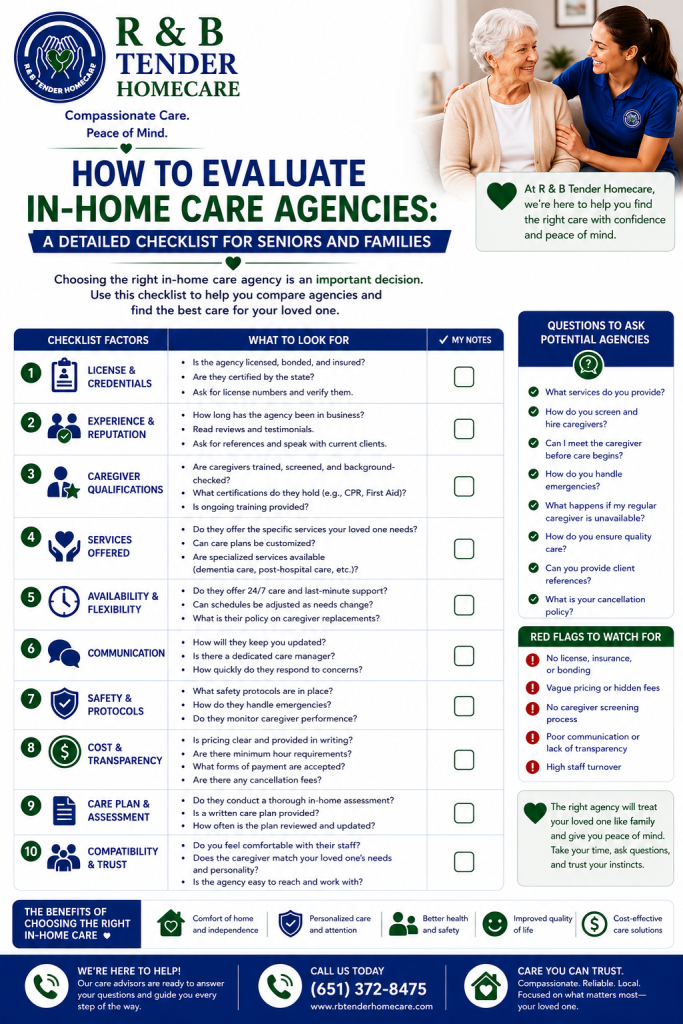
📋 Key Takeaways
- Start by verifying the agency’s licensing, background-check process, caregiver qualifications, and insurance coverage.
- Compare the full range of home care services for seniors, including personal care, companionship, mobility assistance, and specialized support.
- Ask for a written care plan, transparent pricing, emergency procedures, and a clear process for caregiver supervision.
- Reviews, references, communication standards, and caregiver continuity can reveal how an agency performs in real-life situations.
- Use a consistent checklist when comparing in-home care agencies so your decision is based on safety, quality, reliability, and fit.
📑 Table of Contents
- Introduction: Why Choosing the Right In-Home Care Agency Matters
- 1. Verify Licensing and Business Credentials
- 2. Review Caregiver Qualifications and Screening
- 3. Compare Available Home Care Services
- 4. Ask About Personalized Care Planning
- 5. Review Pricing and Contract Terms
- 6. Evaluate Safety and Emergency Procedures
- 7. Check Supervision and Quality Assurance
- 8. Review References and Family Feedback
- 9. Watch for Common Red Flags
- 10. In-Home Care Agency Evaluation Checklist
- ❓ Frequently Asked Questions
Introduction: Why Choosing the Right In-Home Care Agency Matters
Choosing an in-home care agency for an aging parent, spouse, or loved one is an important decision. The caregiver may spend hours inside the senior’s home, assist with personal routines, prepare meals, provide companionship, and help maintain a safe daily environment.
Because the relationship is so personal, families should evaluate agencies carefully rather than choosing the first provider that appears in a search for in-home care agencies near me.
The right agency should combine dependable caregivers, clear communication, personalized services, safety standards, transparent pricing, and a care plan built around the senior’s individual needs.
1. Verify Licensing and Business Credentials
Start by confirming whether the agency meets applicable state requirements.
Home care regulations vary across the United States, so families should ask:
- Is the agency licensed or registered as required by the state?
- How long has the agency been operating?
- Does the agency carry appropriate business and liability insurance?
- Are caregivers employees, contractors, or both?
- Who handles payroll, taxes, and workers’ compensation?
A professional agency should be willing to explain its credentials and provide documentation when appropriate.
2. Review Caregiver Qualifications and Screening
The quality of an agency depends heavily on the caregivers it hires.
Ask how caregivers are screened before entering a client’s home.
A strong screening process may include:
- Criminal background checks
- Employment verification
- Professional reference checks
- Identity verification
- Driving-record checks when transportation is involved
- Verification of relevant training or certifications
Also ask what training caregivers receive in areas such as:
- Personal care
- Fall prevention
- Safe transfers
- Infection prevention
- Dementia support
- Emergency response
Families should also understand how caregivers are matched with each client.
3. Compare Available Home Care Services
Not all home care services for seniors are the same.
Some agencies focus mainly on companionship, while others provide a broader range of personal support.
Common services may include:
- Bathing and grooming assistance
- Dressing support
- Toileting assistance
- Mobility and transfer support
- Meal preparation
- Light housekeeping
- Laundry
- Medication reminders
- Errands and grocery shopping
- Companionship and social interaction
- Transportation assistance
- Respite care for family caregivers
If your loved one has dementia, Parkinson’s disease, limited mobility, or another ongoing condition, ask whether the agency has experience supporting clients with similar needs.
4. Ask About Personalized Care Planning
Quality care should not follow a one-size-fits-all model.
Ask whether the agency completes an initial assessment before services begin.
A personalized care plan should consider:
- Daily routines
- Mobility level
- Personal care needs
- Meal preferences
- Medication reminders
- Cognitive health
- Safety risks
- Social preferences
- Family involvement
Also ask how frequently the care plan is reviewed and how quickly services can be adjusted after a health change, hospitalization, fall, or change in family circumstances.
5. Review Pricing and Contract Terms
Transparent pricing is essential when comparing in-home care agencies.
Ask for a written rate sheet that clearly explains:
- Hourly rates
- Minimum visit requirements
- Weekend rates
- Holiday rates
- Overnight care pricing
- Transportation charges
- Cancellation fees
- Administrative or setup fees
Also review the contract for termination policies, payment schedules, service changes, and notice requirements.
Do not compare agencies using the hourly rate alone. A slightly higher rate may provide better caregiver training, stronger supervision, or more reliable backup coverage.
6. Evaluate Safety and Emergency Procedures
Ask what happens if the caregiver encounters an emergency.
The agency should have clear procedures for situations such as:
- A fall
- A sudden illness
- Difficulty breathing
- A missed medication reminder
- A caregiver failing to arrive
- Severe weather
- A power outage
Families should also ask whether a supervisor or on-call contact is available outside regular office hours.
If the senior has mobility limitations, ask whether the agency provides or recommends a home safety assessment.
7. Check Supervision and Quality Assurance
A good caregiver needs strong agency support.
Ask how the agency monitors service quality.
Important questions include:
- Does a supervisor check in with families?
- How are caregiver concerns reported?
- How are missed visits documented?
- Can families request a different caregiver?
- How quickly does the agency respond to complaints?
- How does the agency handle caregiver call-outs?
Reliable backup coverage is particularly important because seniors may depend on scheduled care for meals, mobility, personal hygiene, or other daily needs.
8. Review References and Family Feedback
Online reviews can provide useful information, but families should look for patterns rather than relying on one positive or negative comment.
Pay attention to repeated feedback regarding:
- Caregiver reliability
- Communication
- Professionalism
- Scheduling
- Billing
- Responsiveness
Ask the agency whether references from current or former clients are available, when appropriate.
9. Watch for Common Red Flags
Be cautious if an agency:
- Cannot clearly explain its screening process.
- Refuses to provide written pricing.
- Provides vague answers about emergency coverage.
- Promises medical services outside its scope.
- Pressures the family to sign immediately.
- Cannot explain how backup caregivers are provided.
- Does not create a written care plan.
Families should feel comfortable asking detailed questions before allowing caregivers into the home.
10. In-Home Care Agency Evaluation Checklist
Use this simple checklist when comparing providers:
| Evaluation Item | Agency A | Agency B | Agency C |
|---|---|---|---|
| Licensing Verified | Yes / No | Yes / No | Yes / No |
| Background Checks | Yes / No | Yes / No | Yes / No |
| Personalized Care Plan | Yes / No | Yes / No | Yes / No |
| Emergency Coverage | 1–10 | 1–10 | 1–10 |
| Pricing Transparency | 1–10 | 1–10 | 1–10 |
| Communication | 1–10 | 1–10 | 1–10 |
For families exploring senior support options in Minnesota, R & B Tender Homecare provides information about home care, residential assisted living, and supportive care services.
❓ Frequently Asked Questions
How do I choose a good in-home care agency?
Compare licensing, caregiver screening, training, services, supervision, emergency procedures, pricing, references, and communication before choosing a provider.
What questions should I ask a home care agency?
Ask about caregiver qualifications, background checks, scheduling, backup coverage, personal care services, emergency procedures, pricing, and how care plans are updated.
What services do in-home care agencies provide?
Services may include personal care, bathing, dressing, meal preparation, housekeeping, companionship, mobility support, medication reminders, transportation, and respite care.
How much does in-home senior care cost?
Costs vary by location, number of care hours, type of service, scheduling, and the senior’s needs. Request a written rate sheet before starting services.
What is the biggest red flag when choosing a home care agency?
Major warning signs include unclear caregiver screening, hidden fees, poor communication, vague emergency procedures, and pressure to sign a contract before the family has reviewed the details.