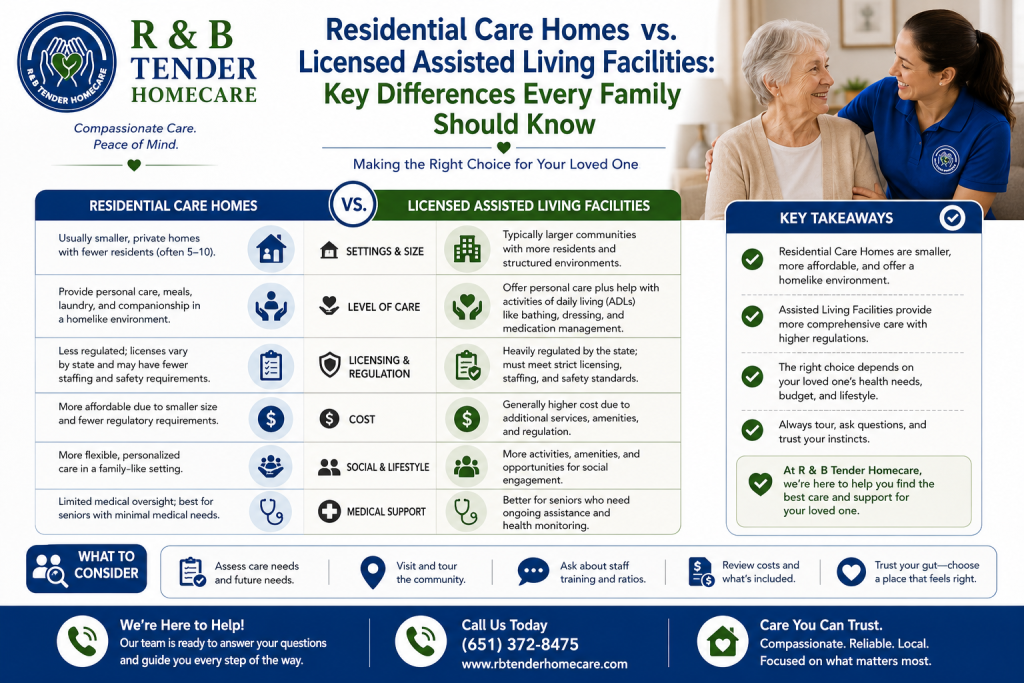
Choosing the right care setting for an aging parent or loved one can be one of the most important decisions a family makes. When comparing residential care homes vs. licensed assisted living facilities, the terminology can sometimes become confusing because different states and providers may use different names for senior living arrangements.
For families in Minnesota, understanding licensing, available care services, living environment, staffing, costs, safety, and the resident’s individual needs can make the decision much easier.
Whether you are researching residential care homes, searching for assisted living facilities near me, or considering a smaller residential assisted living setting, the goal should always be the same: finding a safe, supportive environment where your loved one can maintain dignity, comfort, and as much independence as possible.
Key Takeaways
- Residential care homes generally provide a smaller, more intimate living environment.
- Assisted living facilities provide housing combined with supportive services and must follow applicable state licensing requirements.
- In Minnesota, assisted living facilities are regulated by the Minnesota Department of Health under Minnesota Statutes Chapter 144G.
- The right senior living option depends on the person’s health, mobility, cognitive needs, independence, preferences, and budget.
- Families should compare more than monthly price. Staffing, services, medication support, safety procedures, activities, location, and additional fees are equally important.
- Touring a facility and reviewing its license and service agreement can help families make a more informed decision.
What Is a Residential Care Home?
A residential care home is generally a smaller senior living environment designed to provide personal assistance in a setting that feels more like a traditional home.
Depending on the state, these settings may also be described using terms such as:
- Residential assisted living
- Adult family home
- Board and care home
- Personal care home
- Small assisted living home
The exact legal meaning of these terms varies by state, so families should never assume that the words “residential care home” automatically indicate a particular license or level of care.
Small residential settings are often attractive to families because they may provide fewer residents, familiar caregivers, personalized routines, shared meals, and a quieter atmosphere.
For seniors who prefer a home-like environment instead of a large senior community, residential assisted living can be an appealing option.
What Is a Licensed Assisted Living Facility?
A licensed assisted living facility combines housing with supportive services for adults who may need help with everyday activities while still maintaining a level of independence.
In Minnesota, assisted living facilities are overseen by the Minnesota Department of Health. Minnesota recognizes an assisted living facility license as well as an assisted living facility with dementia care license when applicable.
Depending on the facility and the resident’s care plan, assisted living services may include help with:
- Bathing and personal hygiene
- Dressing and grooming
- Mobility
- Daily routines
- Medication-related support
- Meals
- Housekeeping
- Laundry
- Social activities
- Safety monitoring
- Coordination with healthcare providers
The specific services available should always be confirmed directly with the provider.
Residential Care Homes vs. Assisted Living Facilities: Quick Comparison
| Factor | Residential Care Home | Assisted Living Facility |
|---|---|---|
| Environment | Smaller and more home-like | May range from small residential homes to larger communities |
| Residents | Often fewer residents | Capacity varies significantly |
| Personalization | Often highly personalized | Personalized through individual service plans |
| Daily Activities | Usually smaller-group activities | May offer broader scheduled programming |
| Privacy | Private or shared accommodations depending on provider | Private or shared options may be available |
| Care Services | Vary by provider and license | Based on facility license and resident care needs |
| Medication Support | Depends on services and licensing | May be available according to the resident’s service plan |
| Dining | Often shared, family-style meals | May include communal dining and scheduled meal service |
| Cost | Varies by location and care level | Varies by location, accommodations, and services |
| Licensing | Depends on state requirements and services offered | Must meet applicable assisted living licensing requirements |
The most important point is that size alone does not determine licensing or quality of care. Families should evaluate the actual provider, license, services, staff, policies, environment, and resident experience.
1. Licensing and Regulatory Oversight
Licensing is one of the biggest factors families should investigate when comparing senior living options.
In Minnesota, the Minnesota Department of Health regulates licensed assisted living providers. Its responsibilities include licensure, on-site surveys, enforcement, and communication with providers and consumers.
Minnesota assisted living providers operate under Minnesota Statutes Chapter 144G and related rules.
Families evaluating an assisted living residence should ask:
- Is the residence currently licensed?
- What type of license does it hold?
- What services are included under that license?
- Has the facility undergone state surveys or inspections?
- How are complaints handled?
- What resident rights apply?
- Does the facility provide dementia care?
- What emergency procedures are in place?
Minnesota families can also use state resources to search for assisted living providers and review survey-related information.
2. Size and Living Environment
One of the clearest differences families notice is the physical environment.
Residential Care Homes
Residential care homes often have a more intimate atmosphere. Residents may share dining and living areas, interact with a smaller number of caregivers, and follow routines that feel closer to living in a private home.
This type of environment may be especially attractive to seniors who become overwhelmed in large communities or who simply prefer quieter surroundings.
Larger Assisted Living Communities
Some assisted living facilities operate in larger buildings with numerous residents, apartments, dining rooms, activity spaces, salons, libraries, fitness areas, and transportation programs.
These amenities can be helpful for seniors who enjoy meeting new people and participating in organized activities.
Neither model is automatically better. Personality and personal preference matter.
3. Personalized Care and Attention
Families frequently choose smaller residential assisted living settings because they want their loved one to receive individualized attention.
A smaller environment may make it easier for caregivers to become familiar with a resident’s:
- Daily routines
- Preferred foods
- Mobility needs
- Communication style
- Sleeping habits
- Personal interests
- Cultural preferences
- Social needs
Larger assisted living facilities may also offer individualized service plans, but families should ask how those plans are implemented in everyday care.
When touring any residence, ask how care plans are created, reviewed, and updated when a resident’s condition changes.
4. Assistance With Activities of Daily Living
Many seniors move into assisted living because routine activities have become difficult or unsafe to manage independently.
Common activities of daily living, often called ADLs, include:
- Bathing
- Dressing
- Grooming
- Toileting
- Eating
- Walking
- Transferring from a bed or chair
Families should identify exactly how much assistance their loved one needs before choosing a facility.
Someone who only needs occasional reminders may require a very different care environment from someone who needs hands-on assistance throughout the day.
5. Medication Support
Medication management is an important consideration when evaluating licensed assisted living facilities.
Ask each provider:
- How medications are stored
- Who assists residents with medications
- How medication changes are documented
- How missed doses are handled
- How pharmacies and physicians are contacted
- Whether medication services involve additional charges
Do not assume that every residential setting provides the same level of medication assistance.
6. Health and Nursing Needs
Assisted living is different from a skilled nursing facility.
Families should carefully determine whether the senior’s medical condition can safely be managed in the assisted living setting they are considering.
Important questions include:
- Does the resident require frequent nursing care?
- Is the resident recovering from surgery?
- Does the resident have diabetes?
- Does the resident have mobility limitations?
- Is there a history of falls?
- Does the resident require wound care?
- Is cognitive impairment present?
- Does the resident require specialized dementia support?
Ask the facility what happens when a resident’s healthcare needs increase and what conditions might require a transfer to a higher level of care.
7. Dementia and Memory Care
Families caring for someone with Alzheimer’s disease or another form of dementia should pay particularly close attention to the facility’s license, staffing, safety measures, and dementia-care capabilities.
Minnesota distinguishes between an assisted living facility and an assisted living facility with dementia care. Facilities marketed as providing specialized dementia care, particularly secured dementia settings, are subject to specific licensing requirements.
Ask about:
- Staff dementia training
- Wandering prevention
- Secured areas
- Behavioral support
- Communication techniques
- Nighttime monitoring
- Emergency response procedures
- Cognitive activities
- Family communication
The correct environment can significantly affect a resident’s comfort and daily routine.
8. Socialization and Activities
Senior care should address emotional and social well-being in addition to physical needs.
Isolation can be particularly challenging for older adults.
Residential care homes may provide socialization through smaller-group experiences such as:
- Shared meals
- Games
- Movies
- Gardening
- Holiday celebrations
- Conversations with caregivers
- Community outings
Larger assisted living communities may provide broader activity calendars with exercise programs, entertainment, classes, outings, religious services, and group events.
Families should choose the level of activity that fits the resident’s personality rather than simply selecting the facility with the longest activity calendar.
9. Meals and Nutrition
Nutrition becomes increasingly important as people age.
When touring a residential care or assisted living facility, ask:
- How many meals are provided daily?
- Are snacks available?
- Can special diets be accommodated?
- Are meals prepared on site?
- Can residents request alternatives?
- How does the facility monitor residents who have poor appetites?
- How are allergies handled?
A smaller residential assisted living home may offer a family-style dining experience, while larger communities may operate dedicated dining rooms.
Both approaches can work well when residents receive appropriate nutrition and personal choice.
10. Cost of Residential Care Homes vs. Assisted Living Facilities
There is no single price that applies to every residential care home or assisted living facility.
Costs depend on factors such as:
- Location
- Room type
- Level of personal assistance
- Medication services
- Additional supervision
- Specialized dementia care
- Transportation
- Laundry
- Housekeeping
- Additional healthcare services
Families should request a complete written breakdown before signing an agreement.
Ask specifically whether the quoted monthly amount includes:
- Housing
- Meals
- Personal care
- Medication support
- Housekeeping
- Laundry
- Activities
- Transportation
- Additional nighttime assistance
Understanding the full fee structure makes it easier to compare providers accurately.
11. Safety and Emergency Preparedness
Safety should be a major part of every assisted living tour.
Look for:
- Accessible walkways
- Handrails
- Grab bars
- Adequate lighting
- Smoke and fire safety equipment
- Emergency call systems
- Secure entrances
- Fall-prevention measures
- Emergency evacuation procedures
Also ask what staff members do if a resident falls, becomes ill, experiences a medication issue, or needs emergency medical attention.
12. Resident Rights
Minnesota provides specific rights for people living in assisted living facilities.
Families should understand these rights before admission and make sure the resident understands them whenever possible.
The Minnesota Department of Health provides an Assisted Living Bill of Rights and additional consumer resources for residents, families, and caregivers.
Respect, privacy, communication, choice, dignity, and appropriate treatment should remain central to any senior care environment.
Which Option Is Better for Your Loved One?
There is no universal answer.
A smaller residential assisted living home may be a good fit for someone who:
- Prefers a quiet residential setting
- Enjoys smaller groups
- Benefits from consistent routines
- Values close caregiver relationships
- Wants a home-like atmosphere
- Needs daily personal assistance
A larger assisted living community may be appropriate for someone who:
- Enjoys frequent social activities
- Wants access to multiple amenities
- Prefers apartment-style living
- Likes interacting with larger groups
- Wants extensive scheduled programming
The resident’s needs and preferences should guide the final decision.
Checklist for Choosing an Assisted Living Facility
Before choosing a facility, ask these questions:
- Is the facility properly licensed?
- What level of care can it provide?
- What services are included in the monthly cost?
- Are there additional care charges?
- How are medications handled?
- How are emergencies handled?
- What happens if care needs increase?
- How is the resident’s care plan developed?
- How often is the plan reviewed?
- What meals are provided?
- Are special diets available?
- What activities are offered?
- What are visiting policies?
- How does the facility communicate with families?
- What safety measures are in place?
- What dementia services are available?
- What training do caregivers receive?
- Can families review licensing and survey information?
- What are the discharge or termination policies?
- Can we tour the residence before making a decision?
Residential Assisted Living in Anoka and the Twin Cities
For families searching for residential assisted living in Anoka, Minnesota, or senior care options throughout the Twin Cities area, it is important to look beyond photographs and advertisements.
Visit the residence, talk with caregivers, ask detailed questions, understand the available services, and consider how comfortable your loved one feels in the environment.
R & B Residential Assisted Living provides a home-like residential setting in Anoka, Minnesota, with personalized care designed around resident health, safety, comfort, and daily needs. R & B Tender Homecare also serves individuals and families across Minnesota through its broader network of care and support services.
Services advertised by R & B Residential Assisted Living include 24/7 personal care assistance, medication support, nutritious meals, and individualized care planning.
Looking for Assisted Living in Anoka, MN?
Choosing senior care does not have to be overwhelming.
If you are comparing residential care homes and licensed assisted living facilities near Anoka, Brooklyn Center, Minneapolis, or the Twin Cities, consider scheduling a tour and discussing your loved one’s needs directly with an experienced care team.
A personal visit can help you evaluate the environment, meet the caregivers, understand available services, and determine whether the residence feels like the right home for your family member.
Frequently Asked Questions
What is the main difference between residential care homes and assisted living facilities?
Residential care homes generally describe smaller, home-like senior living settings, while assisted living facilities can range from small residential properties to larger communities. Licensing terminology and requirements vary by state, so families should verify the actual license and services of any provider.
Are residential care homes cheaper than assisted living facilities?
Not necessarily. Pricing depends on location, room type, level of care, staffing, specialized services, and other factors. Always compare the complete monthly cost rather than the advertised base rate.
Is assisted living the same as a nursing home?
No. Assisted living typically supports people who need help with daily activities while maintaining some independence. Nursing homes generally serve individuals who require a higher level of nursing or medical care.
How do I find licensed assisted living facilities near me?
Start with your state’s official health or licensing agency. Minnesota families can use Minnesota Department of Health consumer resources to search for assisted living providers and review available regulatory information.
What should I look for during an assisted living tour?
Look at cleanliness, accessibility, resident interaction, caregiver responsiveness, meals, bedrooms, bathrooms, common spaces, safety measures, activities, and the overall atmosphere. Ask detailed questions about care plans, costs, medications, emergencies, and licensing.
Is a small residential assisted living home better than a large facility?
It depends on the individual. Some seniors thrive in a small, familiar environment, while others prefer larger communities with more residents, amenities, and organized activities.
Final Thoughts
When comparing residential care homes vs. licensed assisted living facilities, families should focus less on labels and more on what actually matters: licensing, safety, services, caregiver support, environment, costs, and the individual needs of the senior.
A smaller residential assisted living setting may provide the warm, personal atmosphere some seniors prefer, while a larger community may provide additional amenities and social opportunities.
For Minnesota families, verifying the provider’s license and reviewing official Minnesota Department of Health resources should be part of the decision-making process.
Most importantly, involve your loved one whenever possible. The best senior living environment is one where they can feel safe, respected, comfortable, supported, and at home.
Contact R & B Residential Assisted Living
If you are exploring assisted living in Anoka, MN, or looking for compassionate senior care in the Twin Cities area, contact R & B Residential Assisted Living to learn more about available services or schedule a facility tour.
R & B Residential Assisted Living
1117 Blackoaks Ct
Anoka, MN 55303
Phone: (763) 327-7426
Email: assistedliving@rbtenderhomecare.com