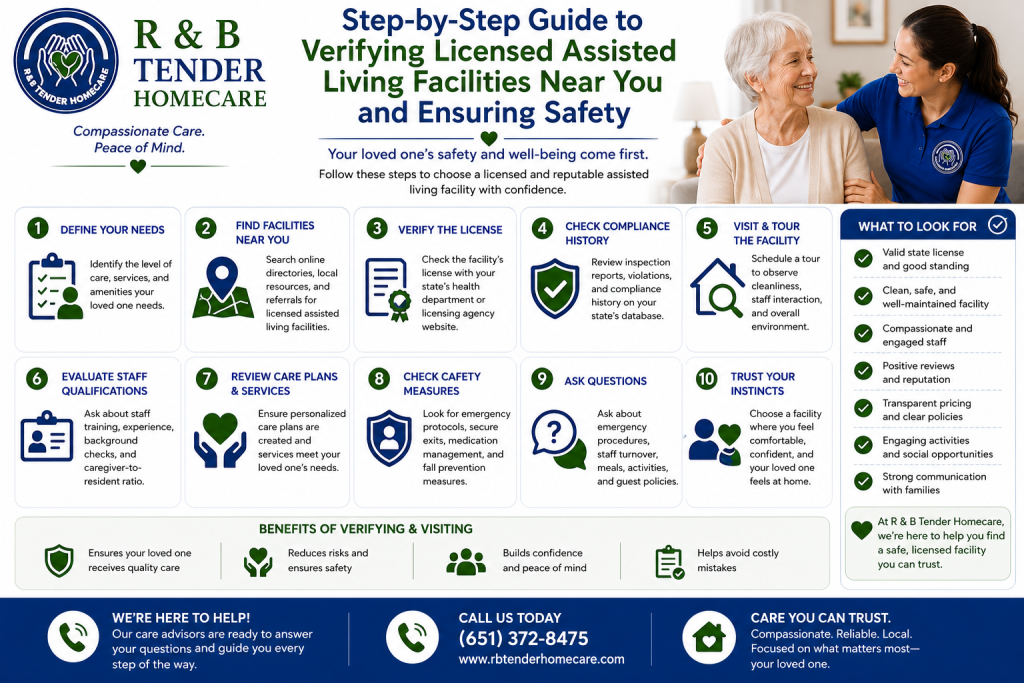
📋 Key Takeaways
- When searching for licensed assisted living facilities near me, start by verifying the provider’s current state license and available inspection information.
- Compare staffing, caregiver training, emergency procedures, medication support, meals, activities, and resident safety—not just monthly price.
- An in-person tour is one of the best ways to evaluate cleanliness, staff interaction, resident comfort, and the overall living environment.
- Request a written explanation of base rates, additional care fees, transportation charges, and contract terms before making a decision.
- Families in Minnesota should compare local assisted living providers based on licensing, care capabilities, location, and the senior’s individual needs.
📑 Table of Contents
- Introduction: Finding the Right Assisted Living Facility
- 1. Verify Licensing and State Oversight
- 2. Evaluate Quality of Care
- 3. Review Inspection and Complaint Information
- 4. Use an On-Site Tour Checklist
- 5. Compare Health and Medication Support
- 6. Evaluate Activities and Quality of Life
- 7. Understand Costs and Contracts
- 8. Compare Facilities Side by Side
- Assisted Living in Minnesota
- ❓ Frequently Asked Questions
Introduction: Finding the Right Assisted Living Facility
Searching for licensed assisted living facilities near me can feel overwhelming, especially when a family is trying to make a safe and timely decision for an aging parent or loved one.
Assisted living communities can differ significantly in size, services, staffing, environment, amenities, and cost. A facility that looks attractive online may not necessarily be the best match for a senior’s health needs, personality, mobility, or daily routine.
The best approach is to compare providers systematically. Families should verify licensing, understand available care, tour the residence, review costs, and ask detailed questions before signing an agreement.
1. Verify Licensing and State Oversight
The first step in evaluating an assisted living provider is confirming that it operates under the appropriate state license.
Assisted living rules in the United States are generally established at the state level, so requirements vary depending on location.
Ask the facility:
- What type of assisted living license do you hold?
- Is the license currently active?
- What services are covered under the license?
- Where can families review inspection or survey information?
- How are resident complaints handled?
A valid license does not automatically guarantee excellent care, but it confirms that the provider is operating within the applicable state regulatory framework.
2. Evaluate Quality of Care
When comparing assisted living facilities near me, quality should be evaluated through everyday operations rather than marketing claims.
Important factors include:
- Caregiver training
- Staff availability
- Response to resident needs
- Care-plan updates
- Emergency procedures
- Communication with families
- Resident dignity and privacy
Ask how new caregivers are trained and whether ongoing education is provided in areas such as dementia care, fall prevention, infection control, medication assistance, and emergency response.
Continuity of care also matters. Seniors may feel more comfortable when they regularly interact with caregivers who understand their routines and preferences.
3. Review Inspection and Complaint Information
Official inspection or survey information can provide useful insight into how a facility meets regulatory requirements.
Families should look for patterns rather than focusing on one isolated issue.
Ask whether previous inspections identified concerns related to:
- Resident safety
- Medication procedures
- Emergency planning
- Staff training
- Documentation
- Resident rights
If deficiencies were found, ask the provider what corrective actions were taken.
Online reviews can also help, but they should not be the only deciding factor. Look for repeated themes involving communication, staff responsiveness, meals, cleanliness, or care quality.
4. Use an On-Site Tour Checklist
An in-person visit is one of the most important parts of choosing an assisted living facility.
During the tour, observe:
- How staff members speak to residents
- Whether residents appear comfortable and engaged
- Cleanliness of rooms and common areas
- Lighting and accessibility
- Bathroom safety features
- Dining areas and meal service
- Emergency exits and safety equipment
Ask specific questions rather than relying on general answers.
Useful questions include:
- How do you respond when a resident falls?
- How are overnight needs handled?
- What happens if a caregiver calls out?
- How often are families updated?
- What happens if the resident’s care needs increase?
5. Compare Health and Medication Support
Older adults may need different levels of assistance with medications and health-related services.
Ask the provider:
- Who handles medication assistance?
- How are medications documented?
- How are medication changes communicated?
- What happens if a dose is missed?
- Can outside healthcare professionals visit residents?
- How are medical appointments coordinated?
Families should also understand the difference between assisted living and skilled nursing. Assisted living supports daily living and personal care, while residents with more complex medical needs may require a higher level of clinical care.
6. Evaluate Activities and Quality of Life
Quality senior care should address more than physical needs.
Social connection, independence, recreation, and meaningful daily routines can greatly affect a resident’s experience.
Look for activities such as:
- Exercise programs
- Games and puzzles
- Arts and crafts
- Music
- Gardening
- Community outings
- Religious or spiritual activities
- Holiday events
Ask to review a current activity calendar.
The best activity program is not necessarily the largest one. It should match the resident’s interests, mobility, personality, and preferences.
7. Understand Costs and Contracts
Assisted living pricing can include a base monthly rate plus additional service charges.
Before signing an agreement, request a written breakdown covering:
- Room or apartment cost
- Meals
- Personal care
- Medication support
- Laundry
- Housekeeping
- Transportation
- Additional supervision
- Dementia-related services
Also review:
- Rate increase policies
- Deposit requirements
- Move-out notice requirements
- Refund policies
- Conditions for discharge or transfer
Comparing complete monthly costs is more useful than comparing advertised starting prices.
8. Compare Facilities Side by Side
After touring several providers, create a simple comparison chart.
| Criteria | Facility A | Facility B | Facility C |
|---|---|---|---|
| Licensing Verified | Yes / No | Yes / No | Yes / No |
| Personal Care Services | 1–10 | 1–10 | 1–10 |
| Safety & Cleanliness | 1–10 | 1–10 | 1–10 |
| Activities | 1–10 | 1–10 | 1–10 |
| Cost Transparency | 1–10 | 1–10 | 1–10 |
A written comparison helps families make decisions based on important facts instead of first impressions alone.
Finding Licensed Assisted Living in Minnesota
Families searching for licensed assisted living facilities near me in Minnesota should compare local providers based on care capabilities, licensing, location, safety, and individual resident needs.
For families in Anoka and surrounding Minnesota communities, R & B Tender Homecare provides information about residential assisted living and senior support options.
Before selecting any provider, schedule a tour and discuss your loved one’s mobility, medications, personal care needs, cognitive health, preferred daily routine, and future care requirements.
❓ Frequently Asked Questions
How do I find licensed assisted living facilities near me?
Start by searching local providers, then verify licensing through your state’s appropriate regulatory agency. Compare services, costs, safety, reviews, and available care before scheduling tours.
What should I look for during an assisted living tour?
Look at cleanliness, accessibility, staff interaction, resident comfort, meals, safety procedures, activities, room options, and emergency planning.
What questions should I ask an assisted living facility?
Ask about licensing, staffing, medication support, personal care, emergencies, costs, activities, communication with families, and what happens if care needs increase.
Is assisted living the same as a nursing home?
No. Assisted living generally supports seniors who need help with daily activities while maintaining some independence. Nursing homes typically provide a higher level of nursing and medical care.
How can I compare assisted living facilities?
Use a side-by-side checklist that scores licensing, care services, safety, cleanliness, activities, staff communication, location, and total monthly costs.