Key Takeaways
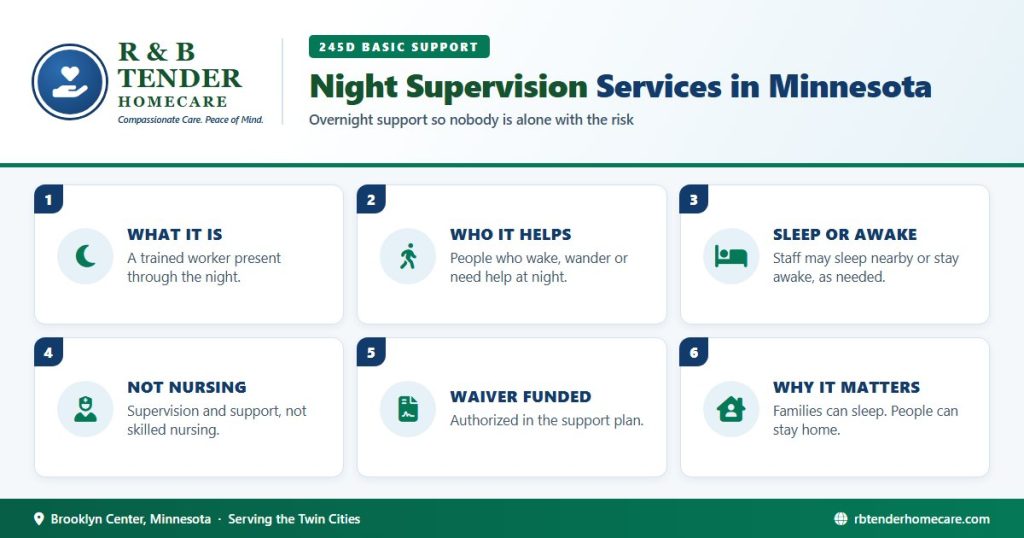
- Night supervision is a Minnesota 245D basic support service that provides a trained worker in the person’s home overnight.
- It is for people who cannot safely be alone at night because of wandering, waking, falls, seizures, behavior or the need for help.
- It is supervision and support, not skilled nursing. If medical care is needed overnight, that is a different service.
- It is usually funded through a waiver program when it is written into the support plan.
- For many families, night supervision is what makes it possible to keep someone at home.
Table of Contents
Days can usually be managed. It is the nights that break families. A parent with dementia who gets up and tries to leave at 3 a.m., an adult son with epilepsy, a daughter who needs turning every few hours: a family caregiver cannot do that every night and still function. Yet the alternative, a move into residential care, often feels too soon.
Night supervision exists for exactly this situation. This guide explains what it is under Minnesota’s 245D licensing, who it helps, how it is funded and how to arrange it.
What Night Supervision Is
Night supervision is one of the basic support services licensed by the Minnesota Department of Human Services under chapter 245D. A trained support worker is present in the person’s home during the night to provide supervision, respond to needs, and keep the person safe.
Depending on the person’s needs, the worker may be awake throughout the night, or may sleep nearby and respond when needed. The support plan sets out which.
Who It Helps
- People with dementia who wake, become confused or try to leave at night.
- People with seizure disorders or other conditions that need someone present.
- People with physical disabilities who need help turning, using the toilet or getting a drink.
- People with behavioral or mental health needs that are harder to manage at night.
- People who are at high risk of falls when they get up in the dark.
- Families where the main caregiver needs to sleep in order to keep caring during the day.
What a Night Supervision Worker Does
- Checks on the person at agreed intervals, or responds when called.
- Helps with getting up, using the toilet and getting back to bed safely.
- Offers reassurance and redirection if the person is confused or distressed.
- Follows the support plan for medication reminders, where that is part of the plan.
- Responds to emergencies and contacts the right people.
- Records what happened during the night and hands over in the morning.
What they do not do is provide skilled nursing. If the person needs nursing procedures overnight, that is arranged separately.
How It Is Funded
Night supervision is usually paid for through one of Minnesota’s home and community-based waiver programs, such as the Elderly Waiver, CADI, BI, DD or CAC. For that to happen, the need has to be identified in the person’s assessment and the service written into the support plan with the hours authorized.
If the person is already receiving waiver services but night supervision is not in the plan, ask the case manager for a review. Be specific about what happens at night and how often. Families can also arrange night supervision privately.
How to Arrange It
- Keep a night log for a week or two. Times the person woke, what happened, what help was needed. This is powerful evidence for an assessor or case manager.
- Raise it with the case manager, or request an assessment through your county or tribal agency if the person is not yet receiving services.
- Choose a 245D-licensed provider and ask about staff training, consistency of workers, and what happens if a worker is unavailable.
- Prepare the home. A place for the worker to sit or sleep, clear instructions, emergency contacts, and the evening and morning routines written down.
- Review after the first few weeks. Needs change. So should the plan.
Questions to Ask a Provider
- Are you licensed under 245D for night supervision?
- How are workers trained, and do they have experience with needs like ours?
- Will it be the same worker most nights?
- What is your plan if a worker calls in sick?
- How do you record the night and communicate with the family?
- How do you handle an emergency?
When Night Supervision Is Not Enough
Night supervision works well when nights are the main problem. If the person also needs a high level of help during the day, or if their needs are increasing quickly, it may be time to look at a residential setting where staff are present around the clock as a matter of course.
That is not a failure of home care. It is the next step on the same path, and the goal is the same: the person is safe, and the family can go on.
Frequently Asked Questions
What is night supervision?
A Minnesota 245D basic support service in which a trained worker is present in the person’s home overnight to supervise, respond to needs and keep them safe.
Is night supervision the same as overnight nursing?
No. Night supervision is supervision and support. Skilled nursing procedures overnight are a separate service.
Who pays for night supervision in Minnesota?
It is usually funded through a waiver program when the service is authorized in the person’s support plan. It can also be arranged privately.
Does the worker stay awake all night?
It depends on the support plan. Some arrangements require the worker to be awake throughout, others allow them to sleep nearby and respond when needed.
How do I get night supervision added to a support plan?
Keep a log of what happens at night, then ask the case manager for a review. If the person is not yet receiving services, request an assessment through your county or tribal agency.
Talk to R & B 245D Support
R & B 245D provides licensed 245D basic support services under the Minnesota Department of Human Services. If you are working out which services fit, we can walk through it with you and your case manager.
This article is general information for families and professionals in Minnesota. It is not medical, legal or financial advice. Programs, rules and eligibility change, so confirm the details with your county or tribal agency, the Minnesota Department of Health or the Minnesota Department of Human Services before you make a decision.