Key Takeaways
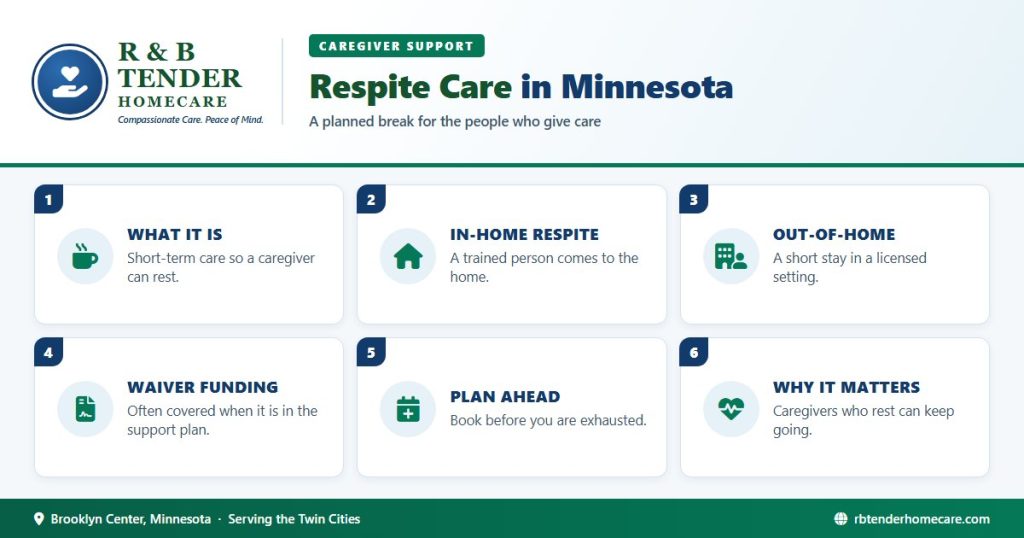
- Respite care is short-term care that gives a family caregiver a break. It can last a few hours, a night or longer.
- It can be provided at home or in a licensed setting outside the home.
- In Minnesota, respite can be paid for through waiver programs when it is included in the person’s support plan.
- Respite is one of the basic support services licensed under Minnesota Statutes chapter 245D.
- Using respite is not a failure. Caregivers who take regular breaks are able to provide care for longer.
Table of Contents
Caring for a family member is rarely a job with set hours. It runs through evenings, nights and weekends, and it often goes on for years. People who do it tend to keep going until they are ill themselves.
Respite care exists to prevent that. This guide explains what it is, the forms it takes in Minnesota, how it can be paid for, and how to set it up.
What Respite Care Is
Respite is short-term care provided because the usual caregiver is absent or needs relief. The person receiving care is supported by trained staff, and the caregiver gets time to rest, work, attend appointments, or simply be somewhere else for a while.
It is not a permanent arrangement and it does not replace the family’s role. It is what makes that role sustainable.
Types of Respite Care
In-home respite
A support worker comes to the person’s home for a set number of hours. Routines stay the same and the person stays in familiar surroundings.
Out-of-home respite
The person stays for a short period in a licensed setting, such as a residential home. This suits longer breaks, including overnight stays or a week away.
Adult day services
A daytime program outside the home that offers activities, meals and supervision, giving the caregiver regular hours to themselves.
Crisis respite
Arranged at short notice when a caregiver is suddenly unable to provide care, for example because of illness.
Who Can Receive Respite in Minnesota
Respite is available to people of different ages and with different needs, including:
- Older adults who need support at home.
- Adults and children with developmental disabilities.
- People with brain injuries, physical disabilities or mental health conditions.
- People with chronic or complex medical conditions.
What matters is that the person needs care or supervision and that their usual, unpaid caregiver needs relief.
How Respite Is Paid For
Families pay for respite privately, or through public programs if the person qualifies.
Minnesota’s home and community-based waiver programs can include respite as a covered service. These include the Elderly Waiver for people 65 and older, and the disability waivers: Community Access for Disability Inclusion (CADI), Brain Injury (BI), Developmental Disabilities (DD) and Community Alternative Care (CAC).
To be funded, respite needs to be written into the person’s support plan by their case manager, with the amount authorized. If you think you need it and it is not in the plan, ask the case manager to review it.
If the person is not on a waiver, start by asking your county or tribal agency for an assessment. The Senior LinkAge Line and Disability Hub MN can also explain the options.
How 245D Licensing Applies
In Minnesota, many home and community-based services are licensed by the Department of Human Services under chapter 245D. Respite is one of the basic support services covered by that license.
A 245D license means the provider must meet state standards for staff training, background studies, service planning, and protecting the rights of the people they support. When you choose a respite provider, asking whether they are 245D licensed is a sensible first question.
How to Arrange Respite
- Speak to the case manager, if there is one, and ask for respite to be added to or reviewed in the support plan.
- Choose a provider. Ask about licensing, staff training, and experience with needs like your family member’s.
- Share the details. Write down routines, medications, food preferences, communication style, and what helps when the person is upset.
- Start small. A few hours first, so everyone gets used to it.
- Make it regular. A planned break every week or month does more good than one emergency break a year.
Letting Go of the Guilt
Almost every caregiver feels guilty about taking a break. It helps to look at it practically. A caregiver who is exhausted makes more mistakes, has less patience, and is more likely to become unwell. If that happens, the person they care for loses their main support altogether.
Respite protects the arrangement. It is part of caring well, not a step away from it.
Frequently Asked Questions
What is respite care?
Short-term care that gives a family caregiver a break. It can be provided at home or in a licensed setting, for a few hours or for several days.
Does Minnesota pay for respite care?
It can, through waiver programs such as the Elderly Waiver, CADI, BI, DD and CAC, when respite is authorized in the person’s support plan.
How do I get respite care in Minnesota?
Speak to the person’s case manager, or ask your county or tribal agency for an assessment if they are not yet receiving services.
Is respite care a 245D service?
Yes. Respite is one of the basic support services licensed by the Minnesota Department of Human Services under chapter 245D.
How often should caregivers use respite?
Regularly, before exhaustion sets in. A planned break every week or month is more effective than waiting for a crisis.
Talk to R & B 245D Support
R & B 245D provides licensed 245D basic support services under the Minnesota Department of Human Services. If you are working out which services fit, we can walk through it with you and your case manager.
This article is general information for families and professionals in Minnesota. It is not medical, legal or financial advice. Programs, rules and eligibility change, so confirm the details with your county or tribal agency, the Minnesota Department of Health or the Minnesota Department of Human Services before you make a decision.