Key Takeaways
- Older adults often take several medications, which raises the risk of mistakes and interactions.
- Most errors are simple: a missed dose, a double dose, or two prescribers who did not know about each other.
- One current medication list and one pharmacy prevent a large share of problems.
- New confusion, drowsiness, dizziness or falls can be a medication effect and should be reported.
- When a person can no longer manage safely, medication help at home or in assisted living is a safety measure, not a loss of independence.
Table of Contents
Many older adults take five or more medications a day, prescribed by different doctors, at different times, with different instructions about food. Keeping that straight is hard for anyone. Add poor eyesight, arthritis in the hands or mild memory loss, and mistakes become likely.
This article explains why problems happen and sets out practical steps for medication management for seniors. It is general information. Always follow the advice of the prescriber and pharmacist, and never stop or change a medication without speaking to them.
Why Medication Mistakes Happen
- Too many medicines. The more there are, the more chances for error and interaction.
- Several prescribers. A specialist may not know what the family doctor prescribed.
- Complicated schedules. Some with food, some without, some twice a day, some once a week.
- Memory changes. Forgetting whether a dose was taken leads to missed or doubled doses.
- Physical difficulty. Small print, child-proof caps and tiny tablets.
- Changes after a hospital stay. New prescriptions are added while old ones are still in the cupboard.
Warning Signs to Watch For
You may notice a problem before your parent does.
- Pill bottles that are fuller or emptier than they should be.
- Out-of-date medicines, or several bottles of the same thing.
- New confusion, drowsiness or dizziness.
- Falls, or unsteadiness that was not there before.
- Loss of appetite, nausea or a change in bowel habits.
- Uncertainty about what a medicine is for.
Any sudden change after a new prescription should be reported to the prescriber or pharmacist promptly.
Six Habits That Prevent Most Mistakes
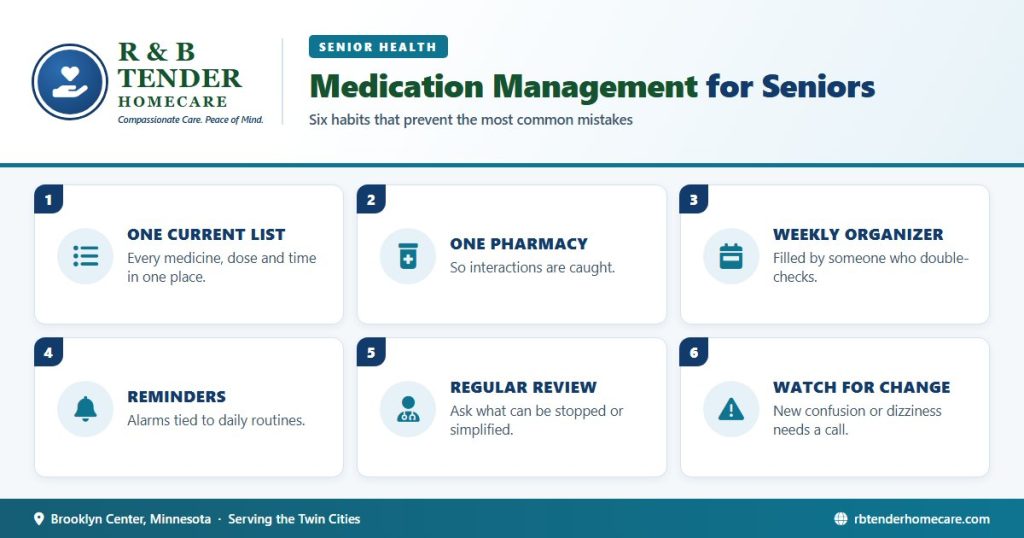
1. Keep one current medication list
Write down every prescription, over-the-counter medicine, vitamin and supplement, with the dose, the time and the reason. Keep a copy in a wallet and one on the fridge. Take it to every appointment.
2. Use one pharmacy
When all prescriptions go through one pharmacy, the pharmacist can see the whole picture and flag interactions.
3. Use a weekly pill organizer
A box with compartments for each day and time makes it obvious whether a dose has been taken. Have a second person fill it or check it. Many pharmacies can also supply medicines in pre-sorted packs.
4. Tie doses to routines
Breakfast, brushing teeth, the evening news. A routine works better than memory. Add a phone alarm or a reminder device if it helps.
5. Ask for a regular medication review
At least once a year, and after any hospital stay, ask the doctor or pharmacist: is every medicine still needed? Can any be stopped? Can the schedule be simplified?
6. Store and dispose of medicines safely
Keep medicines in their original containers, away from heat and damp, and clear out anything expired or no longer prescribed. Pharmacies and local collection programs can take unwanted medicines.
Questions to Ask the Doctor or Pharmacist
- What is this medicine for, and how will we know it is working?
- What side effects should we watch for?
- Does it interact with anything else on the list?
- Should it be taken with food?
- What should we do if a dose is missed?
- Is there a simpler way to take all of these?
After a Hospital Stay
The days after leaving hospital are when medication mistakes are most likely. Before discharge, ask for a clear list of what to take, what has changed, and what should be stopped. When you get home, remove the old medicines from the cupboard so that only the current ones are in use. Then update the medication list and give a copy to the regular doctor.
When Someone Needs Help
There comes a point for some people when an organizer and reminders are no longer enough. Signs include repeated missed or doubled doses, confusion about which pill is which, or a parent who insists they have taken a medicine when the box shows otherwise.
Options include:
- A family member setting up medicines weekly and checking daily.
- Home care services that include medication reminders or administration.
- Assisted living, where trained staff manage and give medications, keep records, and report changes to a nurse.
Accepting this help is often what allows someone to stay well and out of hospital.
How Medication Is Handled in Assisted Living
In a licensed assisted living home in Minnesota, medication management is part of the resident’s service plan. Typically, staff store medicines securely, give them at the prescribed times, record each dose, and tell a nurse or the family if a resident refuses a medicine or seems unwell. A nurse oversees the process.
When you tour a home, ask who gives medications, what training they have, and how errors are prevented and reported. Clear, confident answers are a good sign.
Frequently Asked Questions
How can I help an elderly parent manage their medication?
Keep one current medication list, use one pharmacy, set up a weekly pill organizer that someone double-checks, tie doses to daily routines, and ask for a medication review at least once a year.
What are signs of a medication problem in an older adult?
New confusion, drowsiness, dizziness, falls, loss of appetite, or pill bottles that are fuller or emptier than expected.
What should we do if a dose is missed?
Ask the pharmacist or prescriber. The answer depends on the medicine, and doubling the next dose can be dangerous.
How often should medications be reviewed?
At least once a year, and after any hospital stay or new diagnosis.
Do assisted living homes manage medications?
Yes. In licensed assisted living, trained staff can store, give and record medications as part of the resident’s service plan, with nurse oversight.
Talk to R & B Residential Assisted Living
R & B Residential Assisted Living is a family-owned, licensed home in the Twin Cities area. If you would like to see how a small residential setting works day to day, we are glad to show you around.
This article is general information for families and professionals in Minnesota. It is not medical, legal or financial advice. Programs, rules and eligibility change, so confirm the details with your county or tribal agency, the Minnesota Department of Health or the Minnesota Department of Human Services before you make a decision.