Key Takeaways
- Assisted living residents in Minnesota have rights set out in state law, and providers must give residents a written copy.
- The rights cover dignity, privacy, visitors, involvement in care decisions, information about charges, and freedom from abuse and neglect.
- A resident may raise a complaint without being punished for it. Retaliation is prohibited.
- The assisted living contract sets out the terms for charges and for ending the arrangement. Read it before signing.
- The Office of Ombudsman for Long-Term Care provides free, confidential advocacy for residents and families.
Table of Contents
When a parent moves into assisted living, families naturally focus on the care. It is easy to overlook the fact that the resident has also become a tenant and a consumer with rights that are written into Minnesota law.
Knowing those rights is not about expecting trouble. Most homes respect them as a matter of course. But understanding them helps you ask better questions, recognize when something is not right, and know where to turn. This is an overview of assisted living resident rights in Minnesota. It is general information, not legal advice.
Where the Rights Come From
Assisted living in Minnesota is licensed by the Department of Health under the state’s assisted living law, which came into effect in 2021. That law includes an Assisted Living Bill of Rights.
Providers must give each resident a written copy of these rights. If you were not given one, ask for it. It is a short document and worth reading in full.
The Rights in Plain English
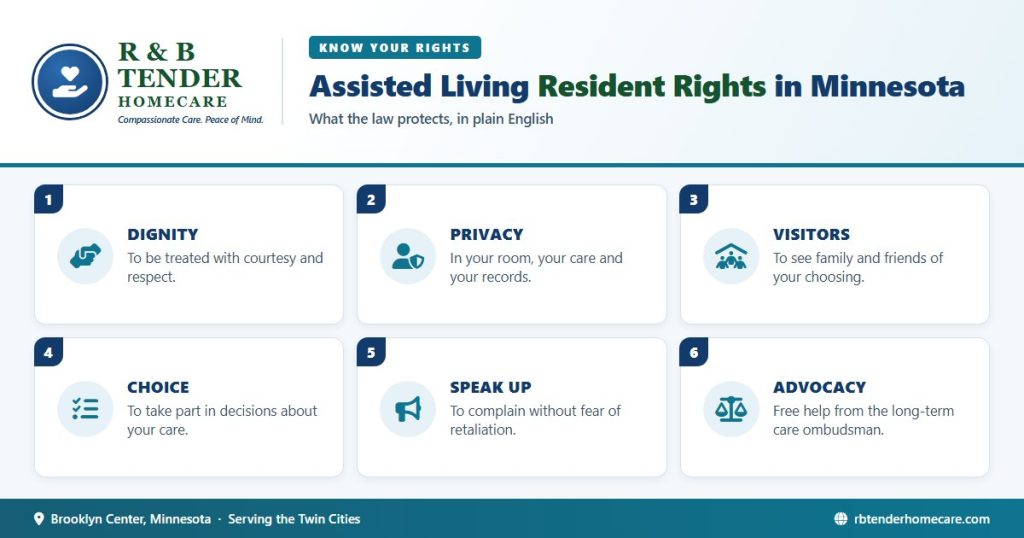
The bill of rights is detailed. In everyday terms, a resident has the right to:
- Be treated with dignity and respect, and to have their property treated with respect.
- Receive appropriate care and services according to an up-to-date plan, from people who are properly trained.
- Take part in planning their care, and to have a family member or representative involved if they wish.
- Refuse care or services, and to be told what the likely consequences are.
- Privacy in their living space, in personal care and in their records.
- Have visitors and to communicate privately with people of their choosing.
- Know what they are being charged and to be told in advance about changes.
- Choose their own outside providers, such as a doctor or pharmacy, where that is possible.
- Be free from abuse, neglect and financial exploitation.
- Complain and to have the complaint dealt with, without retaliation.
The Contract and the Service Plan
Two documents turn these rights into something specific.
The assisted living contract states what the resident is paying for, the charges, how rates can change, and the terms for ending the arrangement. Before signing, read the sections on rate increases, on what happens when care needs change, and on the circumstances in which the home could end the contract.
The service plan describes the care the resident will actually receive. It should be based on an assessment, reviewed regularly, and updated when needs change. Ask for a copy and check that it matches what you were told.
Protection Against Being Asked to Leave
Families often worry that raising a concern, or a decline in a parent’s health, could lead to them being asked to move out.
Minnesota law limits the reasons a provider can end an assisted living contract and sets out a process that must be followed, including written notice and the right to challenge the decision. If you receive a notice of this kind, get advice quickly. The Office of Ombudsman for Long-Term Care can explain the options at no cost.
How to Raise a Concern
- Start with the staff or the person in charge. Be specific about what happened and when. Most problems are solved at this stage.
- Put it in writing if it is not resolved, and keep a copy.
- Contact the Office of Ombudsman for Long-Term Care. The ombudsman is independent of providers and works on behalf of residents.
- Report suspected abuse, neglect or exploitation through the Minnesota Adult Abuse Reporting Center, which takes reports at any time.
- Complain to the Minnesota Department of Health, which licenses and inspects assisted living providers.
If someone is in immediate danger, call 911.
Signs That Rights Are Being Respected
You can tell a great deal on an ordinary visit.
- Staff knock before entering a room.
- Residents are spoken to, not spoken about.
- Your parent is asked what they would like, including small things such as when to get up.
- You are welcome to visit without an appointment.
- Questions about charges are answered clearly.
- Concerns are thanked, not resented.
A home that works this way is not doing so because of the law. It is doing so because that is how good care works.
How Families Can Help
- Keep a copy of the contract, the service plan and the bill of rights together.
- Attend care plan reviews.
- Make sure the home knows who the resident’s representative is, and that legal documents such as a health care directive are on file.
- Visit at different times.
- Raise small things early and politely.
Frequently Asked Questions
Do assisted living residents have legal rights in Minnesota?
Yes. State law includes an Assisted Living Bill of Rights, and providers must give each resident a written copy.
Can an assisted living home restrict visitors?
Residents have the right to have visitors and to communicate privately with people of their choosing, subject to reasonable arrangements set out by the home.
Can a resident be asked to leave for complaining?
No. Retaliation against a resident for raising a concern is prohibited, and the law limits the reasons a contract can be ended.
Who is the long-term care ombudsman?
The Office of Ombudsman for Long-Term Care is an independent Minnesota office that provides free, confidential advocacy for people receiving long-term care services.
How do I report suspected abuse or neglect?
Contact the Minnesota Adult Abuse Reporting Center, which accepts reports at any time. In an emergency, call 911.
Talk to R & B Residential Assisted Living
R & B Residential Assisted Living is a family-owned, licensed home in the Twin Cities area. If you would like to see how a small residential setting works day to day, we are glad to show you around.
This article is general information for families and professionals in Minnesota. It is not medical, legal or financial advice. Programs, rules and eligibility change, so confirm the details with your county or tribal agency, the Minnesota Department of Health or the Minnesota Department of Human Services before you make a decision.