Key Takeaways
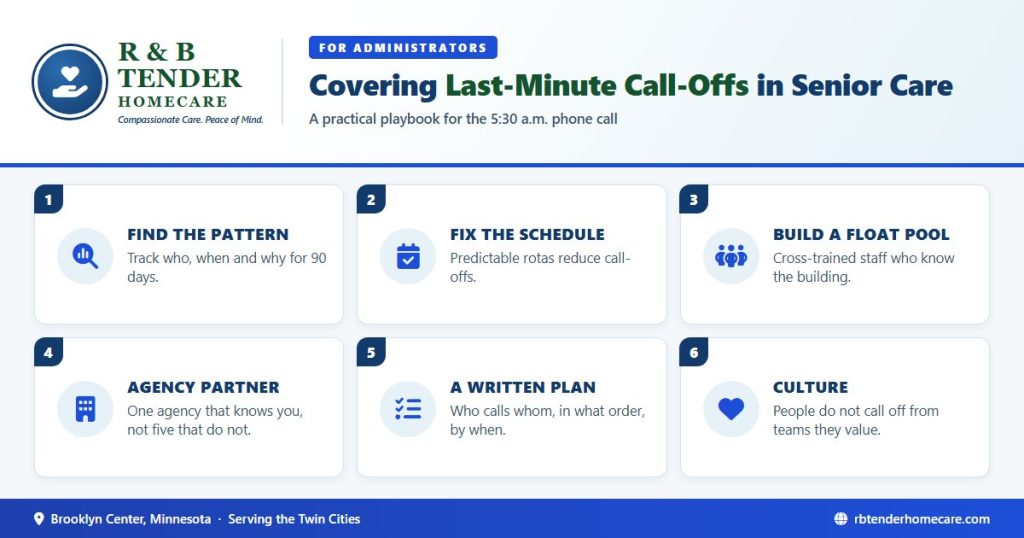
- Call-offs are a data problem before they are a staffing problem. Track them for ninety days and the pattern will tell you where to act.
- Unpredictable schedules cause call-offs. Publishing rotas early and honoring requests reduces them.
- A small internal float pool of cross-trained staff covers most gaps faster than any outside source.
- For the rest, one agency partner that knows your building beats a list of agencies that do not.
- A written escalation plan turns a 5:30 a.m. panic into a procedure.
Table of Contents
Every senior care building deals with call-offs. The difference between a well-run building and a struggling one is not whether staff call off, it is what happens in the next hour. Residents still need to get up, eat and take their medication, and the person covering the phone is usually also trying to cover the floor.
This playbook sets out a practical approach to covering call-offs in senior care: reducing them where you can, and having a reliable plan for the ones that still happen.
Start With Ninety Days of Data
Before changing anything, record every call-off for three months: who, which shift, how much notice, and the reason given. Then look at it.
- Are call-offs concentrated on certain shifts or days? Weekend nights are common.
- Are they concentrated among a few people, or spread across the team?
- Do they cluster after schedule changes, mandatory overtime or a difficult week?
- How much notice do you typically get?
The answers decide whether the fix is scheduling, management, individual conversations or outside support. Often it is more than one.
Reduce Call-Offs by Fixing the Schedule
- Publish schedules early, at least two weeks ahead, and avoid changing them.
- Honor time-off requests made in advance. Staff who cannot get time off properly take it improperly.
- Limit mandatory overtime. Exhausted staff call off.
- Offer self-scheduling or shift swaps within rules, so staff can solve their own conflicts.
- Balance the hard shifts fairly rather than loading them onto the newest or least assertive staff.
Build an Internal Float Pool
The fastest cover is someone who already knows the building. Build a small group of staff who are willing to pick up shifts at short notice and are cross-trained across units.
- Pay a premium for short-notice shifts. It is cheaper than agency rates and far cheaper than a bad day.
- Keep a text list of float staff and their availability, and update it weekly.
- Treat the float pool with respect. They are solving your problem.
Part-time staff who want more hours are often the best candidates.
Choose One Agency Partner, Not Five
Many buildings keep a list of agencies and call down it in a crisis. The result is a different stranger each time, each one needing orientation, each one unknown to the residents.
A better approach is a primary agency partnership: one agency that knows your building, holds your orientation materials, and builds a pool of workers who return regularly. Ask the agency to assign a small, consistent group to your site. Agree response times and escalation contacts in advance, and review performance monthly.
Keep a second agency as a backup, but give the primary one the chance to become part of the team.
Write the Escalation Plan
When the call comes, nobody should be deciding what to do. Write it down and post it at the nurses’ station:
- Within 10 minutes: text the float pool and staff already scheduled for adjacent shifts.
- Within 20 minutes: call the primary agency’s out-of-hours line.
- Within 30 minutes: call the backup agency.
- If still uncovered: the manager on call decides on redistribution, reduced non-essential tasks, or coming in.
Include who has authority to approve premium pay and agency shifts at each step, so nobody is waiting for a sign-off at 6 a.m.
Deal With Repeat Call-Offs Fairly
The data will show whether a few people account for most of the problem. Address it directly and fairly: a private conversation, an attempt to understand what is going on, support where it helps, and clear expectations where it does not. Consistent, documented follow-through protects the staff who do show up, who are watching how you handle it.
The Longer Game: Retention
Buildings with low call-off rates tend to share a few things: managers who are visible on the floor, schedules that are kept, staff who are thanked, training that is taken seriously, and pay that is reviewed. None of these are quick. All of them reduce the number of 5:30 a.m. phone calls over time.
In the meantime, a reliable agency partner is what lets you keep the building running while the longer work is done. R & B Staffing Solutions works with assisted living homes, nursing facilities and hospitals across the Twin Cities area, with staff available around the clock.
Frequently Asked Questions
How can a nursing facility reduce call-offs?
Track them for ninety days to find the pattern, publish schedules early and keep them, limit mandatory overtime, honor time-off requests, and address repeat call-offs fairly.
What is a float pool?
A small group of cross-trained staff who are willing to pick up short-notice shifts, usually for a premium. They know the building, so they are the fastest cover available.
Should we use several staffing agencies?
Keep a backup, but make one agency your primary partner so its workers get to know your building and residents.
What should an escalation plan include?
Who contacts whom, in what order and by when, and who has authority to approve premium pay and agency shifts at each step.
How quickly can an agency fill a same-day shift?
It varies by agency. Agree response times in advance and review them monthly.
Talk to R & B Staffing Solutions
R & B Staffing Solutions is a Minnesota-based healthcare staffing agency supplying nurses and care staff to assisted living homes, hospitals and skilled care facilities.
This article is general information for families and professionals in Minnesota. It is not medical, legal or financial advice. Programs, rules and eligibility change, so confirm the details with your county or tribal agency, the Minnesota Department of Health or the Minnesota Department of Human Services before you make a decision.