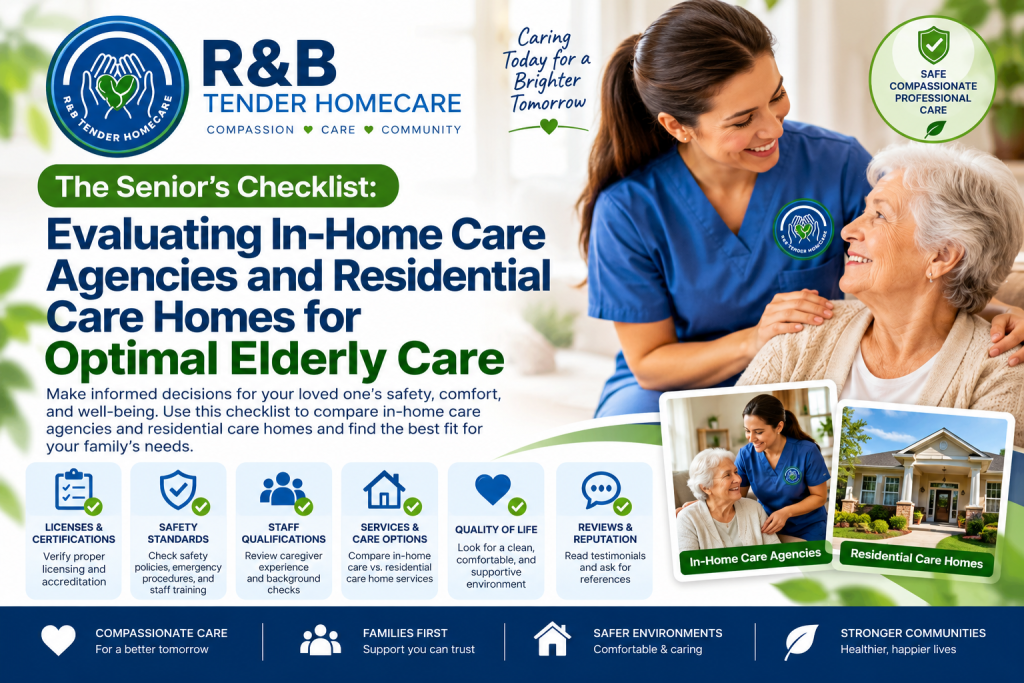
📋 Key Takeaways
- Use a step‑by‑step checklist to compare in‑home care agencies and residential care homes objectively.
- Start with a thorough needs assessment that covers health, mobility, social, and financial factors.
- Verify licensing, staff qualifications, and quality ratings before signing any contract.
- Create a personalized care plan that aligns services with the senior’s goals and preferences.
- Apply a simple scoring matrix to rank providers and avoid common red‑flags.
📑 Table of Contents
- Introduction – why a structured checklist matters for families
- Understanding Elderly Care Options
- Step 1: Conduct a Comprehensive Needs Assessment
- Step 2: Research In‑Home Care Agencies
- Step 3: Tour Residential Care Homes
- Step 4: Compare Costs, Contracts, and Transparency
- Step 5: Verify Licenses and Accreditation
- Step 6: Create a Personalized Care Plan
- Common Pitfalls to Avoid
- Decision Matrix – scoring providers
- Conclusion – next steps
- ❓ Frequently Asked Questions
Introduction – why a structured checklist matters for families
Choosing between in‑home care agencies and residential care homes can feel overwhelming. Families often juggle medical information, budget constraints, and emotional concerns while trying to protect the dignity of their loved one. A systematic checklist transforms that chaos into a clear, comparable set of data points, reducing bias and helping you make an evidence‑based decision.
A well‑designed checklist also serves as a living document. As the senior’s condition evolves, you can revisit each item, update scores, and ensure the care environment continues to meet changing needs.
Understanding Elderly Care Options
Before diving into the checklist, it helps to clarify the two primary elderly care options:
- In‑Home Care Agencies: Licensed providers that send qualified caregivers to a senior’s residence. Services range from personal hygiene assistance to skilled nursing and therapy.
- Residential Care Homes (also called assisted living or licensed assisted living facilities): Physical communities where seniors live independently but receive on‑site support for daily activities, medication management, and social programming.
According to the 2023 National Center for Health Statistics, 35% of adults age 65+ receive some form of home‑based care, while 22% reside in assisted living facilities. Understanding the core differences in setting, staffing, and cost structure is the first step toward a meaningful comparison.
For a deeper dive, see our article Elderly Care Options: Weighing the Pros and Cons of In-Home Care Agencies vs Licensed Assisted Living Facilities.
Step 1: Conduct a Comprehensive Needs Assessment (health, mobility, social, financial)
A needs assessment is the foundation of every subsequent decision. Use the following framework:
- Medical Health
- Chronic conditions (e.g., diabetes, heart disease)
- Medication complexity (number of prescriptions, need for administration)
- Required skilled services (wound care, physical therapy)
- Mobility & Safety
- Fall risk score (use the Timed Up‑and‑Go test)
- Need for adaptive equipment (grab bars, stair lifts)
- Level of supervision required (24‑hour vs. intermittent)
- Social & Emotional Well‑Being
- Desire for community interaction
- Cognitive status (Mild Cognitive Impairment, early dementia)
- Preferred daily routine and hobbies
- Financial Landscape
- Monthly budget for care (including insurance reimbursements)
- Eligibility for Medicaid, VA benefits, or long‑term care insurance
- Potential for out‑of‑pocket expenses
Document each item in a simple spreadsheet. This inventory will later map directly to checklist criteria such as “staff‑to‑resident ratio” or “coverage of skilled nursing”.
Step 2: Research In‑Home Care Agencies – licensing, staff qualifications, service menus, client reviews
When evaluating in‑home care agencies, focus on the following pillars:
Licensing & Regulatory Compliance
- Confirm the agency holds a valid state home‑care license.
- Check for any past violations on the state health department’s website.
- Verify Medicare/Medicaid certification if you plan to use public funds.
Staff Qualifications
- Registered nurses (RNs) or licensed practical nurses (LPNs) for skilled care.
- Certified nursing assistants (CNAs) or home health aides for personal care.
- Background checks and ongoing training records (e.g., dementia care certification).
Service Menu & Flexibility
- Core services: bathing, grooming, meal preparation, medication reminders.
- Skilled services: wound care, IV therapy, physical therapy.
- Customizable schedules (hourly, 24‑hour, live‑in).
Client Reviews & Outcomes
- Read reviews on Google, Yelp, and senior‑specific platforms like Caring.com.
- Ask the agency for references; speak directly with families who have used their services for at least six months.
- Look for measurable outcomes such as reduced hospital readmissions (many agencies track this metric).
For a side‑by‑side comparison of home care versus residential options, consult our guide Home Care Services for Seniors: A Comprehensive Comparison of In-Home Care Agencies and Residential Care Homes.
Step 3: Tour Residential Care Homes – safety features, activity programs, staff‑to‑resident ratios
Visiting a residential care home is essential. Use this on‑site checklist:
Safety & Physical Environment
- Handrails in hallways, non‑slip flooring, and well‑lit pathways.
- Emergency call systems in each unit and common areas.
- Secure medication storage and documented medication administration procedures.
Activity & Social Programming
- Daily calendar of activities (exercise classes, art therapy, outings).
- Specialized programs for memory‑impaired residents.
- Opportunities for family participation (holiday events, visitation policies).
Staff‑to‑Resident Ratios
- State‑mandated minimum ratios (often 1:12 for daytime, 1:20 at night).
- Actual ratios observed during your tour—ask to see staffing schedules.
- Presence of on‑site licensed nurses or physician assistants.
Quality Metrics
- State inspection scores (often available on the state Department of Health website).
- Resident satisfaction surveys and turnover rates.
- Accreditation by organizations such as CARF or The Joint Commission.
If you’re interested in broader guidance on assisted living, read Unlocking the Best Assisted Living Facilities Near Me: A Comprehensive Guide to Senior Care Services.
Step 4: Compare Costs, Contracts, and Transparency – hourly rates, monthly fees, hidden charges
Cost is often the decisive factor. Break down expenses into three categories:
- Base Service Fees
- In‑home agencies: hourly rates typically range from $22‑$35 for non‑skilled care and $35‑$55 for skilled nursing (2024 national average).
- Residential homes: monthly fees range from $3,000‑$5,500 for basic assisted living, with add‑ons (memory care, private rooms) increasing costs by 15‑30%.
- Additional Charges
- Transportation, meals beyond the standard plan, and specialty therapies.
- Late‑night or holiday premium rates for in‑home care.
- Administrative fees or “setup” charges—ask for a written breakdown.
- Contract Transparency
- Length of commitment (often 12‑month minimum for residential homes).
- Notice period for termination or price adjustments.
- Clause for “level‑of‑care escalation” and associated cost increases.
Ask each provider for a “price sheet” and compare side‑by‑side. If a contract contains ambiguous language, request clarification in writing before signing.
Step 5: Verify Licenses and Accreditation – state licensing, Medicare/Medicaid certifications, quality ratings
Verification protects you from fraudulent operators. Follow these steps:
- Visit your state’s Department of Health website and search the provider’s license number.
- Check the CMS Nursing Home Compare tool for residential homes; look for the 5‑star rating (overall, health inspections, staffing, quality measures).
- Confirm Medicare’s “Home Health Agency” certification for in‑home agencies if you plan to use Medicare benefits.
- Look for third‑party accreditation (CARF, The Joint Commission). Accredited facilities must undergo rigorous quality audits.
A quick tip: keep a folder (digital or physical) with PDFs of all licenses, inspection reports, and accreditation certificates for future reference.