Key Takeaways
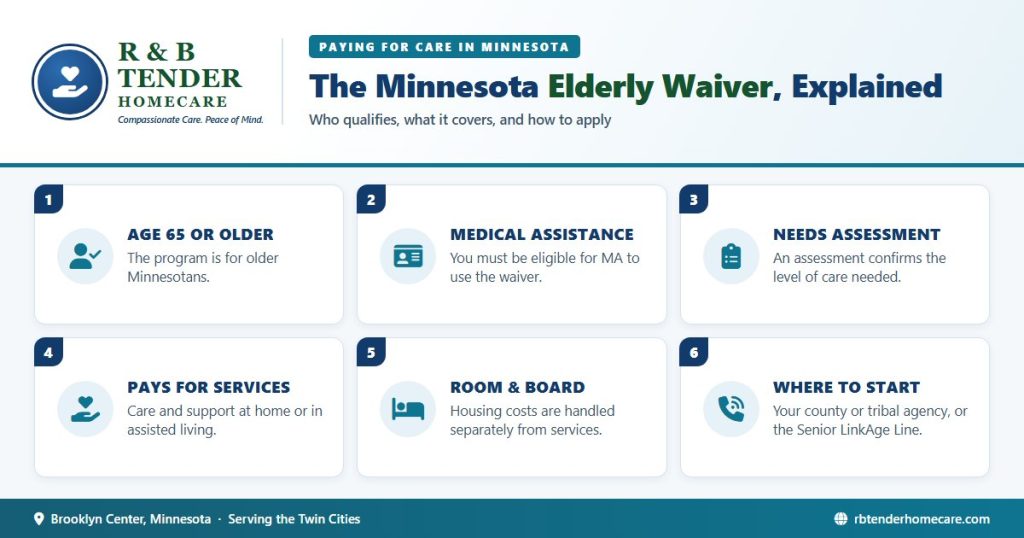
- The Elderly Waiver (EW) is a Minnesota Medical Assistance program that pays for home and community-based services for people aged 65 and older who would otherwise need nursing-home level care.
- It can pay for services delivered in an assisted living setting, which lets many people avoid a nursing home.
- The waiver pays for services, not rent. Room and board is the resident’s responsibility, with separate help available for some people.
- Eligibility has two parts: financial eligibility for Medical Assistance, and an assessed need for a nursing-facility level of care.
- The process starts with an assessment arranged by your county or tribal agency, or your health plan if you are enrolled in one.
Table of Contents
Many families assume that once savings run low, a nursing home is the only option the state will help pay for. In Minnesota that is not the case. The Elderly Waiver exists precisely so that older adults who need a high level of care can receive it at home or in a community setting such as assisted living.
This guide explains the program in plain English: who it is for, what it covers, what it leaves out, and how to begin. Rules and income limits are updated regularly, so treat this as an orientation and confirm the current details with your county or tribal agency.
What the Elderly Waiver Is
The Elderly Waiver is one of Minnesota’s home and community-based services waivers. It is called a waiver because it sets aside the usual Medicaid rule that long-term care is paid for in an institution. Instead, the funding follows the person into the community.
It is run by the Minnesota Department of Human Services and administered locally by counties, tribal nations and managed care organizations. The aim is simple: support people aged 65 and older to live in the least restrictive setting that meets their needs.
Who Qualifies
In broad terms, a person must:
- be 65 or older;
- be eligible for Medical Assistance for long-term care, which involves income and asset rules;
- be assessed as needing a nursing-facility level of care; and
- choose to receive services in the community rather than in a nursing home.
The cost of the person’s community services must also fit within the limits the program sets for their assessed needs.
People with income above the Medical Assistance limit are not automatically excluded. Some qualify by contributing part of their income toward the cost of their care. A county financial worker can explain how this would work in your situation.
What the Elderly Waiver Can Pay For
The services approved depend on the person’s assessment and support plan. They can include:
- Customized living services — the package of care and support provided in an assisted living setting.
- Help with personal care, such as bathing, dressing and moving about.
- Homemaker and chore services.
- Home-delivered meals.
- Adult day services.
- Respite care to give family caregivers a break.
- Case management.
- Certain equipment, supplies and home modifications.
For families considering assisted living, customized living services are the important part. They are what allows a waiver participant to live in a licensed assisted living home and have the care paid for.
What It Does Not Cover
This is the point families most often misunderstand.
The Elderly Waiver pays for services. It does not pay for room and board. Rent, utilities and food are the resident’s own responsibility, usually paid from Social Security and other income.
Some people with low incomes qualify for separate help with housing costs through Minnesota’s Housing Support program. Whether a particular home accepts that arrangement is a question to ask each provider directly.
It is also worth knowing that not every assisted living home accepts the Elderly Waiver, and some limit how many waiver residents they take. Ask early.
How to Apply, Step by Step
- Contact your county or tribal human services agency and ask for a long-term care assessment. If you are not sure who to call, the Senior LinkAge Line can point you to the right office.
- Complete the assessment. An assessor meets with the person, usually at home, to understand their health, daily needs and preferences. In Minnesota this is the MnCHOICES assessment.
- Apply for Medical Assistance if the person is not already enrolled. The financial review runs alongside the needs assessment.
- Develop a support plan. If the person qualifies, a case manager works with them to decide which services they will receive and who will provide them.
- Choose providers. The person chooses from enrolled providers, including assisted living homes that accept the waiver.
The process takes time, so begin before the situation becomes urgent if you can.
If Someone Does Not Qualify Financially
Minnesota also runs the Alternative Care (AC) program for people aged 65 and older who need a nursing-facility level of care and have modest income and assets, but are not yet eligible for Medical Assistance. It covers a narrower range of services and is aimed at helping people remain in their own homes.
A case manager or the Senior LinkAge Line can tell you whether Alternative Care or the Elderly Waiver is the better fit.
Questions to Ask an Assisted Living Home About the Waiver
- Do you accept residents on the Elderly Waiver?
- Do you accept new residents who are already on the waiver, or only residents who move in paying privately and convert later?
- If my family member runs out of private funds, can they stay?
- How is room and board charged for waiver residents?
- Which services are covered by the customized living rate, and which would we still pay for?
Clear answers to these questions prevent the most painful outcome, which is having to move a parent a second time.
Frequently Asked Questions
What is the Elderly Waiver in Minnesota?
It is a Medical Assistance program that pays for home and community-based services for people aged 65 and older who need a nursing-facility level of care but choose to live in the community.
Does the Elderly Waiver pay for assisted living?
It can pay for the services provided in an assisted living setting, known as customized living services. It does not pay for room and board.
How do I apply for the Elderly Waiver?
Contact your county or tribal human services agency and ask for a long-term care assessment. You will also need to apply for Medical Assistance if you are not already enrolled.
What if my income is too high for Medical Assistance?
Some people still qualify by contributing part of their income toward their care. Minnesota also has the Alternative Care program for people who are not yet eligible for Medical Assistance.
Do all assisted living homes accept the Elderly Waiver?
No. Acceptance varies by provider, and some limit the number of waiver residents, so ask each home before you choose.
Talk to R & B Residential Assisted Living
R & B Residential Assisted Living is a family-owned, licensed home in the Twin Cities area. If you would like to see how a small residential setting works day to day, we are glad to show you around.
This article is general information for families and professionals in Minnesota. It is not medical, legal or financial advice. Programs, rules and eligibility change, so confirm the details with your county or tribal agency, the Minnesota Department of Health or the Minnesota Department of Human Services before you make a decision.