Key Takeaways
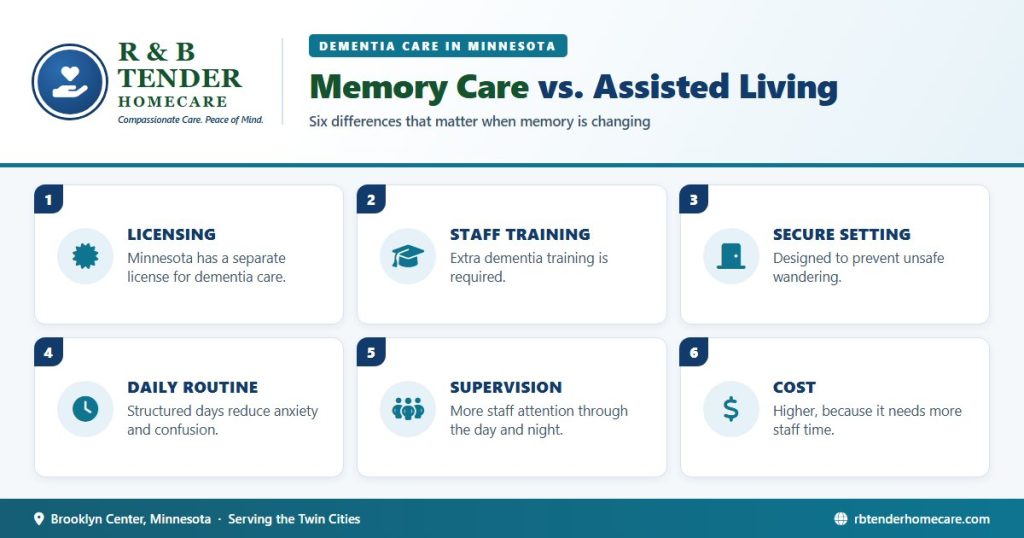
- Assisted living supports people who need help with daily tasks. Memory care is built for people whose memory loss makes ordinary settings unsafe or distressing.
- In Minnesota, a home must hold an assisted living facility with dementia care license before it can advertise specialized dementia care.
- The real differences are staff training, a secure environment, a structured routine and closer supervision.
- A diagnosis alone does not decide the question. Behavior and safety do: wandering, getting lost, night-time waking and distress.
- Many people start in assisted living and move to memory care later, so ask each home how it handles that change.
Table of Contents
A diagnosis of Alzheimer’s disease or another dementia does not come with instructions about where a person should live. Many people with early memory loss do well in ordinary assisted living for years. Others need a specialized setting quite soon. The two options sound similar in a brochure, and families are often unsure which one they are actually looking at.
This guide explains the difference between memory care and assisted living in Minnesota, in terms of what you will see when you walk through the door and what the state requires.
What Assisted Living Provides
Assisted living combines housing with support. Residents typically receive meals, housekeeping, help with personal care such as bathing and dressing, medication management, and a staff presence around the clock.
It works well for people who are broadly oriented and safe, and who need a hand with daily tasks. A resident in assisted living can usually come and go, manage parts of their own day, and ask for help when they need it.
What Memory Care Adds
Memory care is assisted living designed around the needs of people with dementia. The differences are practical.
- A secure environment. Doors, outdoor spaces and layouts are designed so that a resident who walks about cannot leave unsafely.
- Trained staff. Caregivers receive additional training in dementia, including how to communicate and how to respond calmly to distress.
- A structured day. Predictable routines and simple, familiar activities reduce anxiety.
- Closer supervision. Staff offer help rather than waiting to be asked, because a person with dementia may not recognize that they need it.
- An adapted setting. Clear signs, good lighting and uncluttered spaces make it easier to find the way.
How Minnesota Licenses Dementia Care
Minnesota licenses assisted living through the Department of Health and has two license categories:
- Assisted living facility
- Assisted living facility with dementia care
A provider needs the second license to advertise or market specialized dementia care or a secured dementia unit. That license carries additional requirements for staff training and for the physical environment.
This gives families a simple check. If a home describes itself as memory care, ask which license it holds and confirm it with the Department of Health.
Signs That Assisted Living Is No Longer Enough
The decision is rarely about the diagnosis. It is about what is happening day to day.
- Leaving the building and being unable to find the way back.
- Waking and walking about at night.
- Forgetting to eat or drink without prompting.
- Not recognizing the need for help with washing or using the toilet.
- Increasing agitation, suspicion or distress, especially late in the day.
- Being unable to use a call button or ask for help.
If several of these apply, a setting where staff anticipate needs is usually safer than one where the resident is expected to ask.
A Quick Comparison
| Assisted living | Memory care | |
|---|---|---|
| Best for | Help with daily tasks | Memory loss affecting safety |
| Environment | Open | Secured |
| Staff training | General care | Additional dementia training |
| Routine | Flexible | Structured |
| Cost | Lower | Higher |
Where Small Residential Homes Fit
Some people with early or moderate memory loss do very well in a small residential home, even one without a secured unit. The reasons are straightforward: the same few caregivers every day, a quiet and familiar house, and staff who can see every resident from the kitchen.
A small home is not a substitute for licensed dementia care when someone is at risk of leaving unsafely. But for many families it is a good first step, and it is worth asking each home honestly how far they can support a resident as memory loss progresses.
Questions to Ask
- Which Minnesota license do you hold?
- What dementia training do your staff receive, and how often?
- How do you respond when a resident is distressed or refuses care?
- How many staff are on duty at night?
- If my parent’s needs increase, can they stay here?
- How do you keep families involved in the care plan?
Always involve your parent’s doctor in the decision. A medical review can identify treatable causes of confusion and help you judge the level of support that is needed.
Frequently Asked Questions
What is the difference between memory care and assisted living?
Assisted living helps with daily tasks in an open setting. Memory care adds a secure environment, staff with additional dementia training, a structured routine and closer supervision.
Does Minnesota license memory care separately?
Yes. A provider must hold an assisted living facility with dementia care license to advertise specialized dementia care.
Does everyone with dementia need memory care?
No. Many people with early memory loss live well in ordinary assisted living. Memory care becomes necessary when safety or distress can no longer be managed in an open setting.
Is memory care more expensive than assisted living?
Usually, because it requires more staff time and additional training. Ask each provider to price your parent’s specific needs.
When should we move from assisted living to memory care?
When wandering, night-time waking, distress or an inability to ask for help begin to put the person at risk. Their doctor and the care team can help you judge the timing.
Talk to R & B Residential Assisted Living
R & B Residential Assisted Living is a family-owned, licensed home in the Twin Cities area. If you would like to see how a small residential setting works day to day, we are glad to show you around.
This article is general information for families and professionals in Minnesota. It is not medical, legal or financial advice. Programs, rules and eligibility change, so confirm the details with your county or tribal agency, the Minnesota Department of Health or the Minnesota Department of Human Services before you make a decision.