Key Takeaways
- Ice is the biggest winter hazard. One cleared, salted route to the car and the mailbox prevents most falls.
- Older adults lose body heat faster and may not feel the cold until they are already in trouble. A warm home is a safety issue, not a comfort.
- Isolation increases sharply in winter. A daily check-in call is one of the most effective protections.
- Prepare for storms before they arrive: medications, food, water, a charged phone and a plan for a power outage.
- For some families, winter is the season that makes the case for more support or a move.
Table of Contents
Minnesota winters are long, and they are hardest on the people least able to deal with them. Ice on the step, a furnace that fails on the coldest night, weeks when nobody visits because the roads are bad: each one is a risk for an older adult living alone.
This winter safety checklist for seniors in Minnesota is written for families who want to get ahead of the season. Most of it can be done in an afternoon in October.
Ice, Snow and Falls
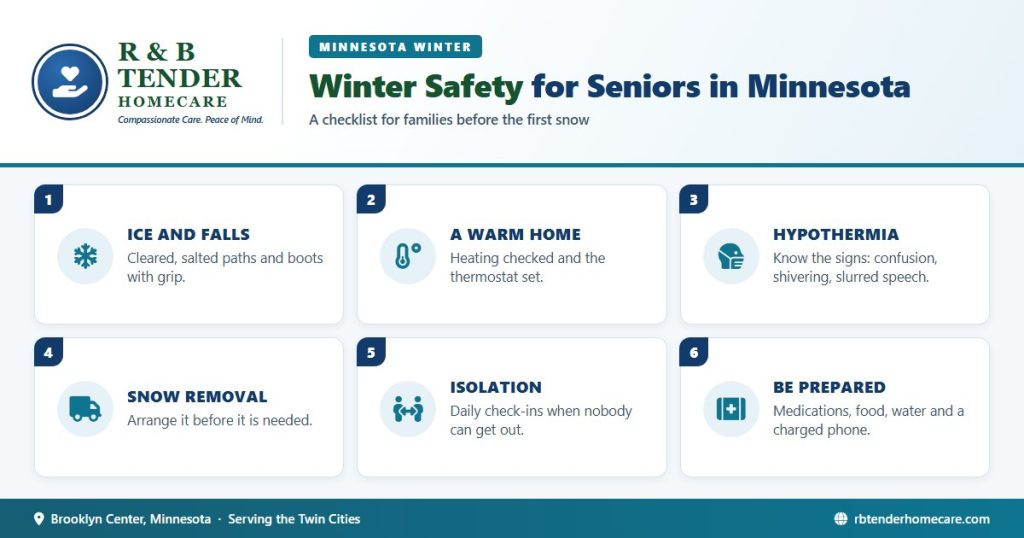
- Arrange snow removal now. A neighbor, a service, or a family rota. Do not leave it until the first storm.
- Keep one route clear from the door to the car and the mailbox, and salt it.
- Fit a handrail at every outside step.
- Buy proper boots with a deep tread, and consider ice cleats that fit over them.
- Light the entrance with a motion-sensor light.
- Keep a bucket of salt and a small shovel inside the door, not in the garage.
- Put down mats inside the door so melting snow does not create a slippery floor.
If conditions are bad, encourage your parent to stay in and have things delivered. A missed errand is better than a broken hip.
Keeping the Home Warm
- Have the furnace serviced before winter, and change the filter.
- Set the thermostat to a steady, comfortable temperature. Turning the heat down to save money is a real risk for older adults.
- Check that windows and doors seal, and close off unused rooms.
- Test carbon monoxide and smoke detectors. Replace batteries.
- Space heaters should be kept well away from bedding, curtains and furniture, and never left running overnight.
- Energy assistance. If heating costs are a worry, Minnesota’s Energy Assistance Program helps eligible households with heating bills. The Senior LinkAge Line can explain how to apply.
Hypothermia: Know the Signs
Older adults lose body heat more quickly and may not notice they are cold. Some medications and conditions make this worse. Hypothermia can develop indoors in a home that is only moderately cold.
Watch for:
- Shivering, or a person who has stopped shivering but is still cold.
- Confusion, drowsiness or slurred speech.
- Cold, pale skin and slow, shallow breathing.
- Clumsiness or a stiff walk.
If you suspect hypothermia, call 911, move the person somewhere warm, and cover them with blankets while you wait.
Isolation and Mood
Winter removes the small contacts that keep people going: the walk to the shop, the chat with a neighbor, church on Sunday. For an older adult living alone, weeks can pass without a face-to-face conversation. Low mood, poor appetite and self-neglect follow.
- Set up a daily check-in call and share it among family members.
- Arrange regular visits, even short ones.
- Help with video calls if your parent is willing.
- Ask about adult day programs or community transport that still runs in winter.
- Make sure the pharmacy and grocery store deliver, so that a bad week does not mean an empty cupboard.
Storm and Power Outage Plan
Put together a kit and keep it somewhere easy to reach:
- At least a week of medications.
- Non-perishable food and bottled water.
- Flashlights and batteries, not candles.
- A charged phone and a backup power bank.
- Blankets and warm clothing.
- A written list of emergency numbers and medications.
If your parent uses equipment that needs power, such as oxygen, tell the utility company in advance and plan where they would go in a long outage.
Driving
Winter driving is hard for everyone. For a parent whose reactions and eyesight are not what they were, it may be the season to stop, or at least to avoid driving in the dark, in snow, or on unfamiliar roads. Arrange alternatives before the subject becomes a confrontation: family drivers, community transport, or delivery services.
When Winter Makes the Case for More Support
Some families get through winter with a checklist and a rota. For others, the season shows that living alone has become too risky: a parent who cannot clear the step, who turns the heat down to save money, or who goes days without seeing anyone.
Help at home for a few hours a day can close some of those gaps. For others, a small residential assisted living home, warm, staffed around the clock and with company at every meal, removes the winter risks altogether. It is worth looking at the options before the first snow rather than after the first fall.
Frequently Asked Questions
What is the biggest winter risk for seniors?
Falls on ice. A cleared, salted path and boots with good grip prevent most of them.
What temperature should an older person keep their home at in winter?
A steady, comfortable temperature. Turning the heat down to save money raises the risk of hypothermia. Ask about energy assistance if cost is a concern.
What are the signs of hypothermia in older adults?
Shivering or having stopped shivering while still cold, confusion, drowsiness, slurred speech, cold pale skin and clumsiness. Call 911 if you suspect it.
How can I reduce winter isolation for my parent?
A daily check-in call shared among the family, regular short visits, help with video calls, and deliveries so bad weather does not mean an empty cupboard.
Is there help with heating bills in Minnesota?
Yes. The Energy Assistance Program helps eligible households with heating costs. The Senior LinkAge Line can explain how to apply.
Talk to R & B Residential Assisted Living
R & B Residential Assisted Living is a family-owned, licensed home in the Twin Cities area. If you would like to see how a small residential setting works day to day, we are glad to show you around.
This article is general information for families and professionals in Minnesota. It is not medical, legal or financial advice. Programs, rules and eligibility change, so confirm the details with your county or tribal agency, the Minnesota Department of Health or the Minnesota Department of Human Services before you make a decision.