Key Takeaways
- Agency staff are an extension of your team. The way an agency screens, trains and supports them lands on your residents.
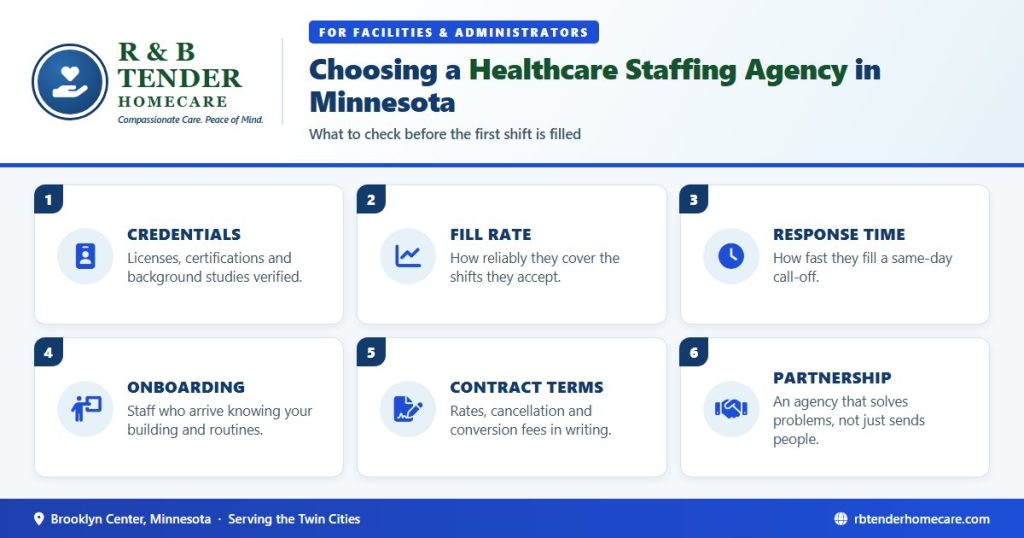
- Verify how the agency confirms licenses, certifications and Minnesota background studies before anyone works a shift.
- Fill rate and response time matter more than the size of the agency’s database.
- Good onboarding, a short orientation, a floor map and the care routines, is what turns a competent stranger into a useful colleague.
- Read the contract for cancellation terms, minimum hours and conversion fees before you need to.
Table of Contents
Every administrator in long-term care knows the feeling: a call-off at 5:30 a.m., a unit short for the day shift, and residents who still need breakfast and medications. Staffing agencies exist to solve that problem. Choosing the wrong one creates a different problem: unfamiliar staff who do not know the building, the residents or the routines.
This guide is for assisted living homes, nursing facilities, group homes and hospitals in Minnesota that are deciding how to choose a healthcare staffing agency. It focuses on the questions that predict how the partnership will actually work.
Credentialing and Compliance
The agency’s compliance is your compliance. Before signing anything, ask:
- How do you verify licenses and certifications for RNs, LPNs, CNAs and other roles, and how often do you re-check them?
- Do all staff have a current Minnesota background study through the Department of Human Services?
- What health screening and immunization records do you hold?
- What training do staff complete, including dementia care, abuse prevention and infection control?
- Can you provide a credential packet for each worker before their first shift?
An agency that hesitates on any of these is not ready to send staff into a licensed setting.
Fill Rate and Response Time
An agency with hundreds of names on file is no use if nobody picks up the phone at 6 a.m. Ask for real numbers:
- What percentage of requested shifts do you fill?
- What is your average time to fill a same-day request?
- How do you handle a worker who cancels on the agency?
- Who do we call out of hours, and will a person answer?
Then check the answers with a reference. Ask another facility whether the agency delivers what it promised.
Quality and Fit
- How do you match staff to settings? Memory care, skilled nursing and a small group home need different people.
- Can we request the same workers again? Consistency improves care and reduces orientation time.
- How do you collect feedback after a shift, and what happens when a facility reports a problem?
- What is your retention rate? Staff who stay with an agency are usually staff who are treated well.
Onboarding: The Part Facilities Control
Even the best agency worker is only as effective as their first thirty minutes in your building. Prepare a short orientation that every agency worker receives on arrival:
- A floor map with exits, call systems and emergency equipment.
- The resident list for their assignment with the essentials: mobility, diet, fall risk, behaviors.
- How medications, documentation and handover work in your building.
- Who is in charge and how to reach them.
Ask the agency how its staff are told to prepare for a new site, and whether it will share your orientation materials with workers in advance.
Contract Terms to Read Twice
- Rates by role, shift and day, including holiday and overtime premiums.
- Minimum shift lengths and what happens if a shift is cut short.
- Cancellation terms on both sides, and the notice required.
- Conversion fees if you later hire an agency worker directly.
- Liability and insurance, including who is responsible for what.
- Invoicing and payment terms.
Negotiate before you are desperate. Terms agreed at 5:30 a.m. tend to favor the agency.
Per Diem, Contract and Temp-to-Hire
Most agencies offer more than one arrangement.
- Per diem — shift by shift, for call-offs and short gaps.
- Contract — a worker placed for a defined period, often weeks or months, for vacancies, leave cover or seasonal demand.
- Temp-to-hire — a trial period that leads to direct employment if both sides agree.
A facility with a steady gap is usually better served by a contract placement than by filling the same shift per diem week after week.
Why Local Matters
A Minnesota-based agency knows the state’s licensing landscape, the background study process, and the realities of getting a worker across the metro in a snowstorm. It can also build a pool of staff who know your building, which is the thing that makes agency staffing feel less like agency staffing.
R & B Staffing Solutions is a Minnesota-based healthcare staffing agency founded by healthcare professionals, supplying nurses and care staff to assisted living homes, hospitals and skilled care facilities across the Twin Cities area, with staff available around the clock.
Frequently Asked Questions
What should a facility check before using a staffing agency?
How the agency verifies licenses and background studies, its fill rate and response time, how it matches and supports staff, and the contract terms for cancellation and conversion.
What is a good fill rate for a healthcare staffing agency?
Ask the agency for its figure and confirm it with a reference. The important thing is that it reliably covers the shifts it accepts, including same-day requests.
Can we request the same agency workers each time?
Many agencies allow it. Consistency improves care and reduces orientation time, so ask before you sign.
What is a conversion fee?
A fee charged if a facility hires an agency worker directly. Check the amount and the conditions in the contract.
What is the difference between per diem and contract staffing?
Per diem fills individual shifts. Contract staffing places a worker for a defined period, which suits longer vacancies and leave cover.
Talk to R & B Staffing Solutions
R & B Staffing Solutions is a Minnesota-based healthcare staffing agency supplying nurses and care staff to assisted living homes, hospitals and skilled care facilities.
This article is general information for families and professionals in Minnesota. It is not medical, legal or financial advice. Programs, rules and eligibility change, so confirm the details with your county or tribal agency, the Minnesota Department of Health or the Minnesota Department of Human Services before you make a decision.