Key Takeaways
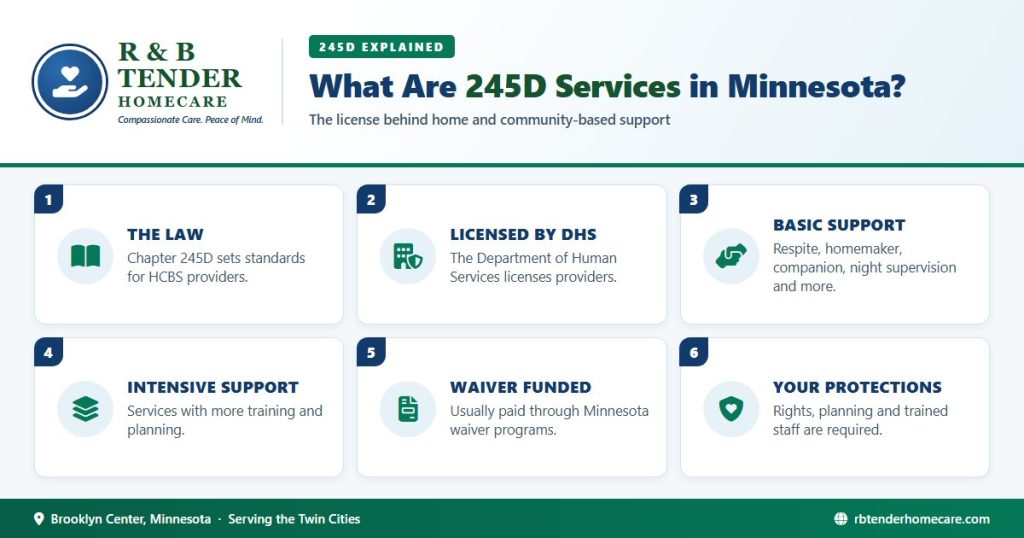
- 245D is the chapter of Minnesota law that sets licensing standards for providers of home and community-based services.
- Providers are licensed by the Minnesota Department of Human Services. A license means the provider meets state standards for staff, planning and rights.
- Services fall into two groups: basic support services and intensive support services.
- Basic support includes respite, homemaker, companion, personal support and night supervision, among others.
- Most 245D services are paid for through Minnesota waiver programs, so the route in is an assessment through your county or tribal agency.
Table of Contents
If you have been through a Minnesota assessment, or spoken to a case manager, you will have heard the term 245D. It appears on provider websites, in support plans and in county paperwork, and it is rarely explained.
This guide explains 245D services in Minnesota in plain language: what the number refers to, what services it covers, who uses them, how they are paid for, and what the license actually guarantees for your family.
Where the Name Comes From
245D is a chapter of Minnesota Statutes. It sets out the standards a provider must meet to deliver home and community-based services, usually shortened to HCBS. These are services that support people with disabilities and older adults to live in their own homes and communities rather than in institutions.
The Minnesota Department of Human Services (DHS) licenses providers under this chapter. When a provider says it is 245D licensed, it means DHS has approved it to deliver these services and holds it to the standards in the law.
Who Uses 245D Services
People of all ages who need support to live in the community, including:
- Older adults who need help to stay at home.
- Adults and children with developmental disabilities.
- People with brain injuries.
- People with physical disabilities or chronic health conditions.
- People with mental health conditions who need support with daily living.
The common thread is that the person is receiving services through one of Minnesota’s publicly funded programs and has a support plan that describes what they need.
Basic Support Services
Basic support services help a person with everyday living and give family caregivers relief. They include:
- Respite care — short-term care so the usual caregiver can take a break.
- Homemaker services — help with cleaning, laundry, shopping and meal preparation.
- Companion services — company, supervision and help with social and leisure activities.
- Personal support — help with daily tasks and community participation.
- Night supervision — overnight support for someone who cannot safely be alone at night.
- Individualized home supports without training — help with daily living in the person’s own home.
- Adult day services and some other day and transport-related supports.
R & B 245D provides licensed basic support services of this kind in the Twin Cities area.
Intensive Support Services
Intensive support services involve more planning, more staff training and more oversight. They include supports that teach new skills, residential services where staff provide a higher level of care, and specialized services for people with complex needs.
A provider must hold the appropriate license for the category of service it provides. If you are being offered an intensive service, ask whether the provider is licensed for it.
How 245D Services Are Paid For
Most 245D services are paid for through Minnesota’s home and community-based waiver programs:
- Elderly Waiver (EW) — for people 65 and older.
- CADI — Community Access for Disability Inclusion.
- BI — Brain Injury waiver.
- DD — Developmental Disabilities waiver.
- CAC — Community Alternative Care, for people with complex medical needs.
Services can also be purchased privately. But for most families, the route in is an assessment through the county or tribal agency, followed by a support plan that lists the services and the amounts authorized.
What a 245D License Guarantees
The license is there to protect the person receiving services. In practical terms, a licensed provider must:
- Complete background studies on staff.
- Provide training before staff work unsupervised, and keep it up to date.
- Develop and review a service plan with the person and their support team.
- Protect the person’s rights, including privacy, dignity and freedom from restraint except in specific, regulated circumstances.
- Have policies for emergencies, incidents and complaints, and report serious incidents.
- Accept DHS licensing reviews.
None of this guarantees a good provider on its own. It does guarantee a floor below which a licensed provider cannot fall.
How to Choose a 245D Provider
- Confirm the license with DHS and check that it covers the service you need.
- Ask how staff are trained and how consistent the staffing will be.
- Ask how the service plan is developed and how often it is reviewed.
- Ask how they communicate with families and the case manager.
- Ask what happens if a staff member cannot make a shift.
- Talk to other families they support if you can.
Frequently Asked Questions
What does 245D mean?
It refers to chapter 245D of Minnesota Statutes, which sets the licensing standards for providers of home and community-based services.
Who licenses 245D providers?
The Minnesota Department of Human Services.
What services are included under 245D?
Basic support services such as respite, homemaker, companion, personal support and night supervision, and intensive support services that involve more training and planning.
How do I get 245D services?
Usually through an assessment arranged by your county or tribal agency, which leads to a support plan and waiver funding. Services can also be purchased privately.
Does a 245D license mean a provider is good?
It means the provider meets state standards for staff checks, training, planning and rights. Choosing well still means asking questions and talking to other families.
Talk to R & B 245D Support
R & B 245D provides licensed 245D basic support services under the Minnesota Department of Human Services. If you are working out which services fit, we can walk through it with you and your case manager.
This article is general information for families and professionals in Minnesota. It is not medical, legal or financial advice. Programs, rules and eligibility change, so confirm the details with your county or tribal agency, the Minnesota Department of Health or the Minnesota Department of Human Services before you make a decision.