Key Takeaways
- MnCHOICES is Minnesota’s single assessment for long-term services and supports. It is the gateway to waiver programs and many other services.
- The assessment looks at health, daily needs, safety, memory, behavior and what the person wants.
- The most common mistake families make is describing a good day. Describe a typical day and a bad day.
- Gather medication lists, diagnoses and legal documents beforehand, and have someone present who sees the daily reality.
- The outcome is a support plan and, if eligible, a case manager who helps arrange services.
Table of Contents
Almost every publicly funded long-term care service in Minnesota starts with one thing: an assessment. For most people that is the MnCHOICES assessment, carried out by a certified assessor from the county, tribal nation or health plan.
Families often go into it unprepared, answer questions from memory, and understate how hard things have become. The result can be a support plan that does not match the real need. This checklist explains what the assessment covers, how to prepare, and what to expect afterwards.
What MnCHOICES Is
MnCHOICES is the assessment tool Minnesota uses to decide whether a person qualifies for long-term services and supports and, if so, what they need. It is used for older adults and for children and adults with disabilities. The same assessment is the way into the Elderly Waiver, CADI, BI, DD and CAC waivers, the Alternative Care program, and other services.
It is carried out in person, usually at the person’s home, by a certified assessor. It takes time. Expect a couple of hours or more.
How to Request One
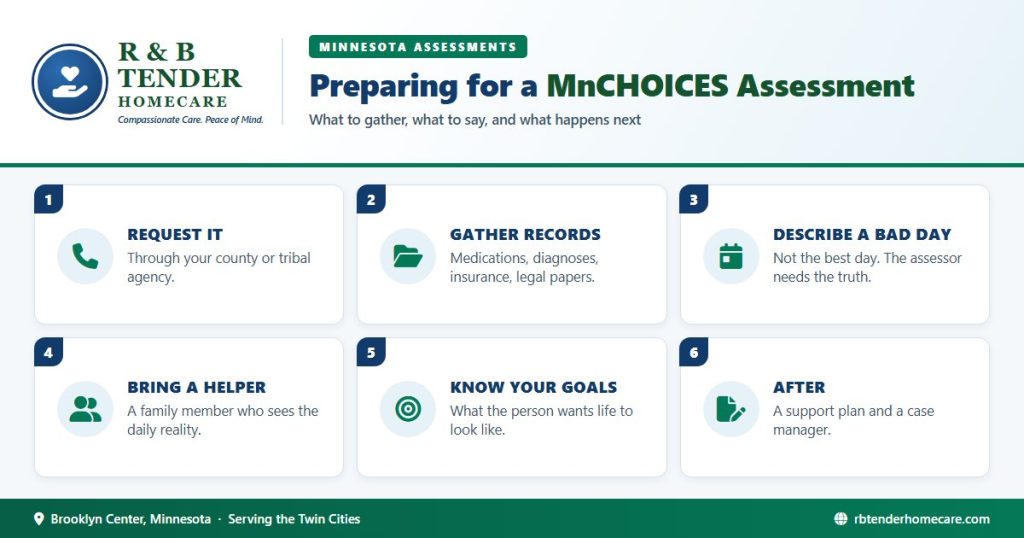
Contact your county or tribal human services agency and ask for a long-term care consultation or MnCHOICES assessment. If the person is enrolled in a managed care health plan, the plan may arrange it. The Senior LinkAge Line and Disability Hub MN can tell you who to call.
There is no charge for the assessment.
What the Assessor Will Ask About
- Health: diagnoses, medications, recent hospital stays, pain.
- Daily living: bathing, dressing, eating, using the toilet, moving about, transferring.
- Household tasks: cooking, cleaning, shopping, managing money and medications.
- Memory and thinking: orientation, judgment, safety awareness.
- Behavior and mood: anxiety, agitation, wandering, resistance to care.
- Safety: falls, being alone, night-time needs.
- Current support: who helps now, how much, and whether they can keep going.
- Goals: what the person wants their life to look like.
What to Gather Beforehand
- A current medication list.
- A list of diagnoses and the doctors involved.
- Insurance information, including Medicare and Medical Assistance details.
- Legal documents: health care directive, power of attorney, guardianship papers.
- Any recent hospital or clinic paperwork.
- Notes on falls, incidents and hospital visits over the past year, with dates.
- A written description of a typical day and what help is given at each point.
Describe the Bad Days
This is the single most important piece of advice. People want to appear capable, especially to a stranger, and on the day of the assessment they often rally. Family members, out of loyalty, go along with it.
The assessor needs the truth. If your parent can dress themselves on a good day but needs full help on a bad day, say so. If they have not bathed without help in months, say so. If they are up three times a night, say so. Understating the need does not protect the person’s dignity. It leaves them without the support they are entitled to.
Be specific and give examples. “She needs reminding” is weaker than “without a reminder she missed her blood pressure medication four times last week”.
On the Day
- Have a family member or caregiver present who sees the daily reality.
- Let the person speak for themselves where they can, and add detail where they cannot.
- Ask questions. What programs might apply? What happens next? When will we hear?
- Take notes and ask for the assessor’s contact details.
- Talk about goals. Staying at home, getting out more, giving a caregiver a break. The support plan is built around them.
What Happens Afterwards
The assessor determines whether the person meets the level of care for a program and what services are needed. If the person is eligible, a support plan is written, and a case manager is assigned to help choose providers and put services in place. Financial eligibility for Medical Assistance is reviewed separately by a financial worker.
If you disagree with the outcome, you have the right to appeal. Ask the assessor or case manager how.
Assessments are repeated at least once a year, and you can ask for a reassessment sooner if needs change.
Frequently Asked Questions
What is a MnCHOICES assessment?
Minnesota’s in-person assessment for long-term services and supports. It determines eligibility for waiver programs and other services and identifies what the person needs.
How do I get a MnCHOICES assessment?
Ask your county or tribal human services agency, or your managed care health plan. There is no charge.
How long does the assessment take?
Usually a couple of hours or more, carried out at the person’s home by a certified assessor.
What should I bring to the assessment?
A current medication list, diagnoses, insurance details, legal documents, notes on falls and hospital visits, and a description of a typical day.
What if I disagree with the result?
You have the right to appeal. Ask the assessor or case manager for the process, and you can request a reassessment if needs change.
Talk to R & B 245D Support
R & B 245D provides licensed 245D basic support services under the Minnesota Department of Human Services. If you are working out which services fit, we can walk through it with you and your case manager.
This article is general information for families and professionals in Minnesota. It is not medical, legal or financial advice. Programs, rules and eligibility change, so confirm the details with your county or tribal agency, the Minnesota Department of Health or the Minnesota Department of Human Services before you make a decision.